

This week I was fortunate to be able to share a message at the North Tryon Presbyterian Church, in Prince Edward Island, my home faith community. I based the message, loosely, on the HWL blog posting, “Riv: I Plead my Case.” [Please note that, although I normally use the Hebrew name Yeshua in the blog posting, I will sometimes use the English adaption of Jesus, if that is what’s familiar to the congregation (such as below)]. This message will also be, eventually, added to YouTube. Once that’s done, I will attach a link to the bottom of the posting.
*****************************************************************
Hello everyone! Happy May the 4th… be with you. Anyone a Star Wars fan? Sorry to report this message will not be Star Wars related, although I did (briefly) think about it. Instead, let’s see if you can guess the theme of today’s message by listening to the following introduction of a famous TV show. Here we go…
In the criminal justice system…
Anybody?
…the people are represented by two separate yet equally important groups: the police, who investigate crime; and the district attorneys, who prosecute the offenders. These are their stories… dun! dun!
Yes, Law & Order. Today we’re going to look at some Biblical “courtrooms”.
So according to the show, Law & Order, the people are represented by the police who keep them safe and the prosecuting lawyers who put the criminals away. But not all who are accused are guilty, so defense lawyers are provided to protect the accused and try to prove their innocence. It’s important to have defense lawyers in a society that aims to be just and fair, wouldn’t you agree?
Without defense lawyers you get trials much like Jesus had… sham trials with false witnesses and false accusations.
Let’s think about the courtroom. There’s the accused, the reason the courtroom has gathered. There’s a judge who presides over the courtroom and makes the final decision. There’s a prosecuting lawyer who tries to prove the guilt of the accused. And there’s a defense lawyer who tries to maintain the accused innocence. And, finally, there’s the jury, a group of the accused peers who listen to the lawyers and recommend that the judge find the accused guilty or innocent.
That’s a human courtroom. But God doesn’t play by human rules. His courtroom is rather different, and today we’re going to unpack that.
Now I know we’ve just been through Easter, but we’re going to go back to the time of Jesus’ two trials… he had two trials… before His brutal execution. And I want to go back there because I think it’s part of the Easter/Passover story that often gets skipped. Even though we’re the ones who should be on trial, it’s Jesus who faced the jury… and it was a very biased jury.
Jesus, if you recall, was arrested later in the evening. Jesus and the disciples had a Passover meal and then they wandered to the Mount of Olives where Jesus prayed in what would be his final hours. After this, Jesus was arrested at which point the disciples ran away, in fear, abandoning Jesus to His fate.
Can you imagine if all your friends and family ditched you at the first sign of trouble?
Jesus’ first trial was in the middle of the night in the Sanhedrin, filled with his religious peers. After they found Him guilty they handed Him over to the Romans for another trial in order to have Him executed under Roman law.
Jesus had no defence lawyer and He had no impartial judge or jury. It was a sham trial without mercy or justice.
The Old Testament had a lot to say about legal proceedings, particularly focusing on the concept of a legal defender who would plead the case of someone who had been accused. This was a repeated theme, that God is our legal defender
YHWH was presented as a defence lawyer AND a merciful judge. See how His courtroom is different?! There are numerous examples of people praying to God, and God defending their case:
Psalm 43:1
Vindicate me, O God, and plead my case!
Lamentations 3:58
O Lord, You have pleaded my soul’s cause; You have redeemed my life.
Proverbs 22:22-23
Do not rob the poor because he is poor, or crush the afflicted at the gate; for YHWH will plead their case and take the life of those who rob them.
Proverbs 23:10-11
Do not move the ancient boundary or go into the fields of the fatherless, for their Redeemer is strong; He will plead their case against you.
YHWH is the best defense lawyer you can have. Regardless of how guilty you are, He can, and will, clear your name.
Here’s probably my favourite Old Testament passage (actually a small part of it is on a tombstone with my name on it, behind this church)…
Micah 7:7-9
But as for me, I will watch expectantly for YHWH; I will wait for the God of my salvation. My God will hear me.
Do not rejoice over me, O my enemy. Though I fall I will rise; though I dwell in darkness, YHWH is a light for me.
I will bear the indignation of YHWH because I have sinned against Him, until He pleads my case and executes justice for me. He will bring me out to the light, and I will see His righteousness.
I bear God’s anger because it should be on me. I had one job to do: be God’s reflection on this earth. Sinning is simply misrepresenting God by word and deed. What have I done? I’m judgemental, I can be gossipy, I can walk by someone in need and not do anything. This is not bearing God’s image; this is not being the kind of human I was made to be. And so God has every right to be angry and disappointed with me, but NOTE that although I am guilty of these things, God still pleads my case like a good lawyer.
God is both our defence lawyer AND our judge! And He has no desire to be a prosecuting attorney because He does not want us to bear the guilt we deserve.
God’s Adversary, the Satan, does want you to bear the guilt. He wants you to feel guilty and worthless, and deserving of death. And your jury of peers often sides with this harsh prosecuting attorney. Sometimes we are that jury. And we have to be very careful that we don’t judge others on Satan’s behalf… and that includes ourselves. If you tell yourself that you’re stupid, or worthless, or ugly, then you’re prosecuting yourself in Satan’s courtroom. You’re doing his work and you’re doing it well.
God, on the other hand, is the extraordinary lawyer who tells us this: If you’re found guilty, I’ll bear the punishment on your behalf. The sentence will fall on Me; you don’t have to bear it.
This is the message of the Bible, and it’s extraordinary! No human lawyer in their right mind would offer that deal! Can you imagine?! Imagine a lawyer offering to do jail time if their client was found guilty. Their careers would be very short and no one would want to become a lawyer!
The truth is, we are guilty. We are guilty of not living up to our life’s purpose. We are guilty of misrepresenting YHWH on earth, but YHWH is going to remove that sin and find us guiltless. How? How do you remove the guilt of a person?
How do we humans punish the guilty? We send them to jail, and it wasn’t that long ago that we also executed people for certain crimes.
But, remember, God does not play by human rules. His plan to exonerate the guilty is remarkable. In His infinite wisdom He simply decided to shift the guilt of humanity onto Himself. He would pay the price of our failures by bearing a human form and taking the ultimate punishment: death. And so Jesus comes onto the scene to become the sacrificial lamb who will bear the sins of the whole world.
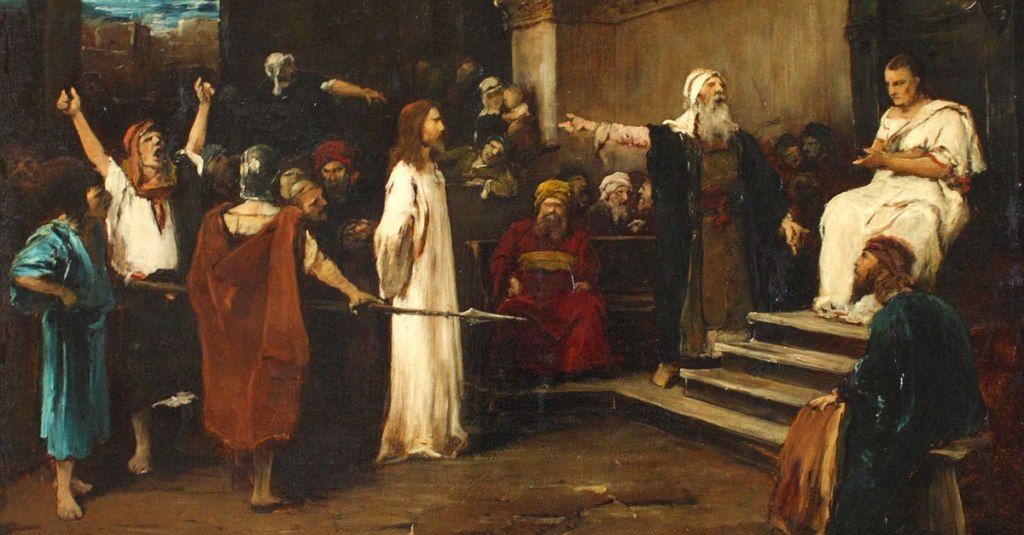
So let’s look at these two trails. Jesus’ sacrifice begins when He’s arrested and His disciples abandon Him.
Matthew 26:57-68
Those who had seized Jesus led Him away to Caiaphas, the high priest, where the scribes and the elders were gathered together. But Peter was following Him at a distance as far as the courtyard of the high priest, and entered in, and sat down with the officers to see the outcome.
Now the chief priests and the whole Council kept trying to obtain false testimony against Jesus, so that they might put Him to death. They did not find any, even though many false witnesses came forward. But later on two came forward, and said, “This man stated, ‘I am able to destroy the temple of God and to rebuild it in three days.’”
The high priest stood up and said to Him, “Do You not answer? What is it that these men are testifying against You?” But Jesus kept silent. And the high priest said to Him, “I adjure You by the living God, that You tell us whether You are the Messiah, the Son of God.”
Jesus said to him, “You have said it yourself; nevertheless I tell you, hereafter you will see the Son of Man sitting at the right hand of Power, and coming on the clouds of heaven.”
Then the high priest tore his robes and said, “He has blasphemed! What further need do we have of witnesses? Behold, you have now heard the blasphemy; what do you think?”
They answered, “He deserves death!”
Then they spat in His face and beat Him with their fists; and others slapped Him, and said, “Prophesy to us, You Messiah; who is the one who hit You?”
Jesus knew exactly who hit Him. Satan had control of this courtroom. The judge, the jury, and the prosecuting lawyer had all attacked Him.
Jesus was in a room with 70 of His peers. And they found him guilty on the basis of some weak witnesses and their own fear and biases. And Peter was there too, hiding in the crowd. He never rushed in to defend Jesus or tried to dissuade the accusations. Out of fear he did nothing and Jesus was found guilty.
Now the Jewish leaders did not have the ability to execute people; they had to go through Roman Law to do that. And so Jesus was sent to His second trial with the Roman Governor, Pilate, as His judge.
Matthew 27:11-14
Meanwhile Jesus stood before the governor, who questioned Him: “Are You the King of the Jews?”
“You have said so,” Jesus replied. When he was accused by the chief priests and the elders, he gave no answer.
Then Pilate asked him, “Don’t you hear the testimony they are bringing against you?”
But Jesus gave no answer, not even to a single charge, much to the governor’s amazement.
Pilate was confused. Why wasn’t this man defending Himself? Why did He remain silent when He should have been fighting for His life?
Jesus’ “No comment” attitude certainly was not helping His case. It’s interesting to note, though, that this was not the first time someone questioned God’s ability to defend Himself:
Psalm 74:22-23
[Asaph:] Rise up, O God; defend Your cause! Remember how the fool mocks You all day long. Do not disregard the clamour of Your adversaries, the uproar of Your enemies that ascends continually.
You see, God did not come to prove His power, or take vengeance on guilty humans; He came to prove that might isn’t always right and that love and compassion are better than weapons and war. He came to teach us that there’s a better way to live.
Jesus did not plead his own case. He was neither lawyer nor judge in His own trial. He laid down His power, and like a submissive servant He laid down His own life. This was not the kind of Messiah the people wanted or expected. They wanted Him to be a freedom fighter against Rome… and that’s not what Jesus came to do. He had a much bigger task to accomplish (beyond our limited understanding). And so, in a Passover ritual, Jesus the Messiah was placed in comparison to a man who represented the kind of Messianic figure the people were looking for… a man that we know as “Barabbas”.
But there’s more to his story than most of our Biblical translations let on. The earliest New Testament scrolls tell us Barabbas’ first name. If you have an NIV Bible or some of the more obscure translations, you’ll see this name in the text, but most of our modern translations do not include it, even though most contemporary New Testament scholars argue that the inclusion of this name is legitimate for a variety of reasons… and yet, many of our Bible translations leave it out.
Does anybody know, or can you guess, what Barabbas’ first name is? It is…
…Jesus (which comes from the Hebrew word meaning “Salvation”)
We have two men named Jesus’ in this story! Bar’abbas means son of (bar) the father or rabbi (abbas or rabbas). So you have Jesus, son of the human father and Jesus, Son of God. Both are named Salvation. The question becomes, what kind of saviour do you want to follow? This is what the story is asking of you.
Barabbas wanted to rebel against the political Roman rule and reclaim Jewish authority with the sword. In the 23rd chapter of Luke we read that Barabbas was imprisoned for an insurrection in the city, and for murder.
Do you want to follow Barabbas, a freedom fighter, willing to kill for his cause? Or do you want to follow Jesus, Son of God, who brought salvation in the most, seemingly, un-heroic way, by laying down His life in servitude, love and humility.
Jesus’ second trial sealed His fate, and helped to complete His mission:
Matthew 27:15-26
Now it was the governor’s custom at the festival to release a prisoner chosen by the crowd. At that time, they had a well-known prisoner whose name was Jesus Barabbas.
So when the people gathered together, Pilate said to them, “Whom do you want me to release for you: Jesus Barabbas, or Jesus who is called Christ?”
For he knew that it was because of envy that they had handed Him over. And while he was sitting on the judgment seat, his wife sent him a message, saying, “See that you have nothing to do with that righteous Man; for last night I suffered greatly in a dream because of Him.”
But the chief priests and the elders persuaded the crowds to ask for Barabbas, and to put Jesus to death. And the governor said to them, “Which of the two do you want me to release for you?”
And they said, “Barabbas.”
Pilate said to them, “Then what shall I do with Jesus who is called Christ?”
They all said, “Crucify Him!”
But he said, “Why, what evil has He done?”
Yet they kept shouting all the more, saying, “Crucify Him!”
Now when Pilate saw that he was accomplishing nothing, but rather that a riot was starting, he took water and washed his hands in front of the crowd, saying, “I am innocent of this Man’s blood; you yourselves shall see.”
And all the people replied, “His blood shall be on us and on our children!”
Then he released Barabbas for them; but after having Jesus flogged, he handed Him over to be crucified.
This was the human courtroom at its worst.
YHWH, as judge, has found us guilty, but Jesus, our defence lawyer, opted to bear the punishment so that we don’t have to.
Do you believe power and prestige makes you victorious? In your anger do you desire revenge? Do you think might is always right? Then you are a follower of the Jesus Barabbas movement.
Jesus Barabbas killed in order to “save” his people. Jesus son of God died to save His people. This is the extraordinary gift of GRACE given to us at the cross! We can’t be in God’s Presence laden with guilt, so Jesus took the guilt upon Himself. He paid our entrance fee into the Garden Kingdom of Heaven.
These two men named Jesus have polar opposite life philosophies… and the people, during the Jesus trial, made a clear choice. Their verdict? Let the murderous Barabbas be set free. He will be our saviour against Rome. Kill the innocent Jesus for He is of no use to us.
It was an upside down verdict, but it was also a necessary verdict if Jesus was going to fulfill His mission.
Psalm 103:8-12
YHWH is compassionate and gracious, slow to anger, abounding in loving devotion.
He will not always accuse us, nor harbour His anger forever.
He has not dealt with us according to our sins or made us pay according to our iniquities.
For as high as the heavens are above the earth, so great is His loving devotion for those who fear Him.
As far as the east is from the west, so far has He removed our transgressions from us.
Jesus paid the ultimate price to wipe out our debt and clear our name. He is our self-sacrificing defense lawyer and we owe him our lives. Let’s honour it by being as Jesus-like as we can be. Let’s look like Jesus more than we look like Barabbas, because the world needs much less rage, condemnation and death, and much more mercy, forgiveness and love.
Our guilt has been removed, but we are given a life sentence: we get to live, eternally! Let’s never take that for granted.
[NOTE: You can view the recorded message here. The audio isn’t the best. You may want to click on the transcript provided by YouTube to read along.]
Next week: Bitter

 Hebrew Word Lessons
Love this. So wonderful to read.
LikeLike
Thank you, Glenn!
Sarah
LikeLike