

Praise Psalm: mizmor, masculine noun (Strong’s 4210)
Original text: מִזְמוֹר Root: זָמַר
Sounds like: meez’mohr
In 2005 an archeological dig unearthed a stunning mosaic floor near Tel Megiddo, Israel. This discovery remained outside of public attention until only recently when scholars released their studies on this incredible finding. This mosaic floor, which included three mosaic inscriptions, was part of a small Christian gathering space. One of the inscriptions reads as follows, “Akeptous, the friend of God, has offered the table to God Jesus Christ (for) remembrance.” Greek grammar tells us that Akeptous was a woman and she provided the means for a communion table to be placed in this small (5×10 meter) gathering room for prayer, ritual, and praise.
Remarkably this is one of the earliest examples of text that declares Yeshua’s (Jesus’) divinity (“God Jesus Christ”). The discovery of this slice of early Christian faith has a lot to tell us. Within the three inscriptions there were seven names mentioned. Gaianos, a centurion, was listed as commissioning the mosaics and Brutus was listed as the mosaic artisan. Akeptous commissioned the communion table, and four other women (Primilla, Cyriaca, Dorothea, Chreste) were to be “remembered”. Out of the seven names listed in these inscriptions, five were women.
The early Christian movement was likely very appealing to women. The region where this floor was found was part of Samaria in the days of Yeshua. Samaria was where Yeshua spoke to the woman at the well in John 4. She was so delighted and impacted by her conversation with Yeshua that she ran into town announcing that the long-awaited Messiah had arrived. She was the first missionary of Yeshua’s ministry. At His resurrection, Yeshua commissions Mary Magdalen to run and tell the disciples of His return, announcing the Good News as the first evangelist. Yeshua radically stood out in support of women’s involvement in His Kingdom ministry, allowing them to be disciples and leaders in the new Christian movement. This was revolutionary for women who had, for centuries, been deeply entrenched in the very limiting patriarchal Greco-Roman world. We should not be surprised that women were attracted to a God-centered social movement which gave them a new sense of worth and the freedom to be equally expressive in their faith.
The discovery of this “prayer room” (or perhaps, “house church”) tells us that a gathering place was important for the early followers of Yeshua. They would have joined together for communion, prayer, and song in a time when it was potentially dangerous to hold such beliefs. Prayer and praise were central to the early Christian gatherings, just as it is today.
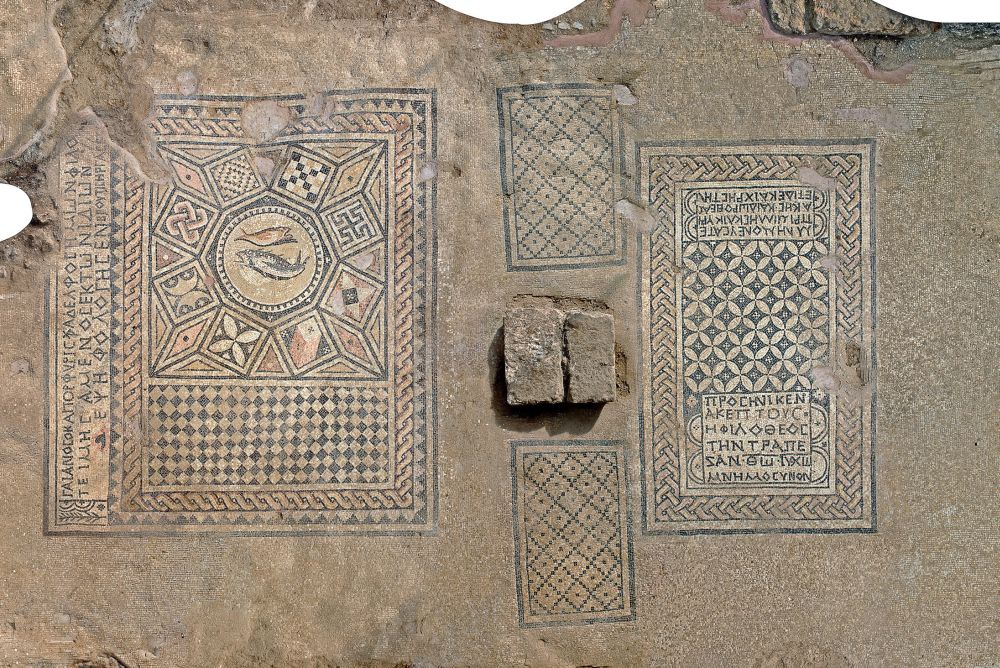
In this posting we are going to explore the Hebrew word mizmor, found frequently in the poetic portions of our Bibles. Mizmor is often translated as “psalm”, but the Biblical book which we, in English, call “The Psalms” is called, in Hebrew, Tehillim (not mizmor). So if tehillim are the psalms, what is mizmor?
Mizmor seems to indicate a piece of music or melody which was intended to offer praise to YHWH. Not all psalms were praise psalms, but the psalms identified as mizmor songs seemed to focus on praise rather than lament or epic poetry, although that might be a generalization which would benefit from a more detailed study.
The etymology of the word “psalm” is extensive. It came from the Greek “psalmos”, meaning “song sung to a harp”. In Latin that became “psalmus”;, in Old English it was a psealm, and in modern English, psalm. Our collection of psalms can be referred to as the Psalter. A Psalm was a musical collection of poetry which emphasised praise, thanksgiving, supplication, and lament. It could be said that mizmor was a psalm but not all psalms were mizmors.
Mizmor comes from the verb zamar (Strong’s 2167), which has been translated as, “to make music”, suggesting a strong musical, melodic, element to mizmor. [As an aside, it is worth noting that neither of these words (mizmor or zamar) show up in the Torah].
The celebratory poem of Deborah and Barak was the first to incorporate the word zamar. They “made music” to YHWH after their great victory against the Canaanites. It was a melody of praise:
Judges 5:1-3
Then Deborah and Barak the son of Abinoam sang on that day, saying,
“For the leaders leading in Israel, for the people volunteering, bless YHWH!
Hear, you kings; listen, you dignitaries! I myself—to YHWH, I myself will sing, I will sing praises [make praise music: a’zamehr אֲזַמֵּ֕ר] to YHWH of Israel!”
The next time this word shows up in the text is when David sings a praise song of thankfulness for surviving Saul’s attempt to take his life:
2 Samuel 22:47-51 (See also 1 Chronicles 16)
[David:] “YHWH lives, and blessed be my Rock; and exalted be my God, the rock of my salvation, the God who executes vengeance for me, and brings down peoples under me, who also brings me out from my enemies; You also raise me above those who rise up against me; You rescue me from the violent person.
Therefore I will give thanks to You, YHWH, among the nations, and I will sing praises [make praise music: a-zamehr אֲזַמֵּֽר] to Your name. He is a tower of salvation to His king, and shows favour to His anointed, to David and his descendants forever.”
Mizmor and the Psalmic Preamble
Whereas the verb zamar can be found within the body of many of the psalms, mizmor is a noun that is exclusively found in the instructional introduction of a psalm. According to the Masoretic text, (the original source for most of our modern Bibles), fifty-seven out of one hundred and fifty psalms have an introductory preamble which includes mizmor, such as the miz’mor l-David or the the miz’mor l-Asaph.
In Hebrew miz’mor l-David hyper-literally means a Psalm TO David, not of David. This does not mean it was written by somebody else and given to David. David, in these cases, is the indirect object, so it simply means that the particular psalm belongs TO David. It’s like saying , A Psalm (attributed) to David, or Aspah, or the Sons of Korah etc.
These Psalmic preambles may also indicate the circumstances which led to the writing of a particular psalm. For example:
Psalm 3:1-4
A Psalm (Praise) of David [miz’mor l-David מִזְמ֥וֹר לְדָוִ֑ד], when he fled from his son Absalom.
YHWH how my enemies have increased! Many are rising up against me. Many are saying of my soul, “There is no salvation for him in God.” Selah
But You, YHWH are a shield around me, my glory, and the One who lifts my head.
I was crying out to YHWH with my voice, and He answered me from His holy mountain. Selah
A preamble may also tell us the original purpose of the psalm or the location of its debut performance: :
Psalm 30:1-3
A Praise song [Miz’mor shir מִזְמ֡וֹר שִׁיר]at the Dedication of the House of David.
I will exalt You, YHWH, for You have lifted me up, and have not let my enemies rejoice over me.
YHWH my God, I cried to You for help, and You healed me. YHWH, You have brought up my soul from Sheol; You have kept me alive, that I would not go down to the pit.
To help us understand the concept of mizmor, we can compare it to another term commonly found to describe a psalm: a maskil. For example, of the twelve psalms attributed to Asaph in the Mazoretic text, nine were listed as miz’mor l-Asaph. Of the other three, Psalm 81 just says, “of Asaph”, indicating neither a miz’mor or a maskil, and the final two (Psalm 74, 78) were identified as a maskil l-Asaph.
Maskil has popularly been described as a thoughtful or contemplative piece, but a skillful psalm might be a better translation. Maskil is connected to the root word sakal, meaning prudent, wise, insightful, successful. Here is the beginning of one of Asaph’s maskils:
Psalm 78:1-3
A Maskil of Asaph.
Listen, my people, to my instruction; incline your ears to the words of my mouth. I will open my mouth in a parable; I will tell riddles of old, which we have heard and known, and our fathers have told us.
This psalm is an epic tale outlining the history of the Hebrew people, starting from the time of Jacob and including YHWH’s intervention in Egypt, the people’s rebellion against God, God’s continuing faithfulness (regardless of the people’s hard hearts), the people’s arrival in the promised land, the choosing of Judah and the line of David, and the building of YHWH’s sanctuary on Mount Zion. This is an epic, delicately woven, poem and, assuming skillful is the most accurate translation, worthy of the identification “maskil”.
A miz’mor psalm was, of course, also skillfully written, but it tended to put the focus on the creative expression of praising YHWH, first and foremost. Again it’s worth noting that mizmor was a psalm but not all psalms were mizmors, sometimes they were maskils, epic tales, and undefined poems within the collection.
It may be most helpful to think of a mizmor as a song that placed praising YHWH as its primary goal. Let’s take a look at a few of these praise-filled poetic songs:
Psalm 66:1-3a
For the music director. A Song (of) praise [Shir miz’mor שִׁ֣יר מִזְמ֑וֹר].
Shout joyfully to God, all the earth; sing the glory of His name; make His praise glorious. Say to God, “How awesome are Your works!”
Psalm 67:1
For the music director; with stringed instruments. A praise song: [miz’mor shir מִזְמ֥וֹר שִֽׁיר].
God be gracious to us and bless us, and cause His face to shine upon us— Selah That Your way may be known on the earth, Your salvation among all nations. May the peoples praise You, God; may all the peoples praise You.
Psalm 92:1-4
A Praise Song [miz’mor shir מִזְמ֥וֹר שִׁ֗יר] for the Sabbath day.
It is good to give thanks to YHWH and to sing praises to Your name, Most High; to declare Your goodness in the morning and Your faithfulness by night, with the ten-stringed lute and with the harp, with resounding music on the lyre. For You, YHWH, have made me joyful by what You have done, I will sing for joy over the works of Your hands.
Psalm 98:1-2
A Psalm [A Praise: Miz’mor מִזְמ֡וֹר]
Sing a new song to YHWH, for He has done wonderful things, His right hand and His holy arm have gained the victory for Him. YHWH has made His salvation known; He has revealed His righteousness in the sight of the nations.
From the time of Deborah and David, through to the second Temple period, the time of Yeshua and the apostles, and all the way to today… we have been praising YHWH for centuries. Perhaps it’s a bit romantic to imagine a small group of people, in a little house church in the year 230, gathering together to praise YHWH. Gaianos and Akeptous may have stood side by side, remembering their sisters in Christ, dedicated on the floor of their gathering place. I can imagine them reciting a song of thanksgiving and praise (miz’mor) before they shared communion together:
Psalm 100
A Psalm for Thanksgiving [A Praise of Thanksgiving: miz’mor l-todah מִזְמ֥וֹר לְתוֹדָ֑ה]
Shout joyfully to YHWH, all the earth. Serve YHWH with jubilation; come before Him with rejoicing. Know that YHWH Himself is God; it is He who has made us, and not we ourselves; we are His people and the sheep of His pasture. Enter His gates with thanksgiving, and His courtyards with praise.
Give thanks to Him, bless His name. For YHWH is good; His mercy is everlasting and His faithfulness is to all generations.
Next week: Musician

 Hebrew Word Lessons
May Our Lord bless and keep you under His wings now and for ever more. Praise His Hold Name.
Amen
Lea Rabkin
LikeLike