

Rock: tsur, masculine noun (Strong’s 6697)
Root: צוּר
Sounds like: tsoor
Earlier this month I had the great pleasure of hanging out with my best friend and our families at Hopewell Rocks in New Brunswick… a collection of stunning, gravity defying, rock formations. It certainly helped put in perspective the reason why so many of the Bible’s writers used the word Rock to describe YHWH. The vastness, strength and grandeur of these rocks were something to behold.
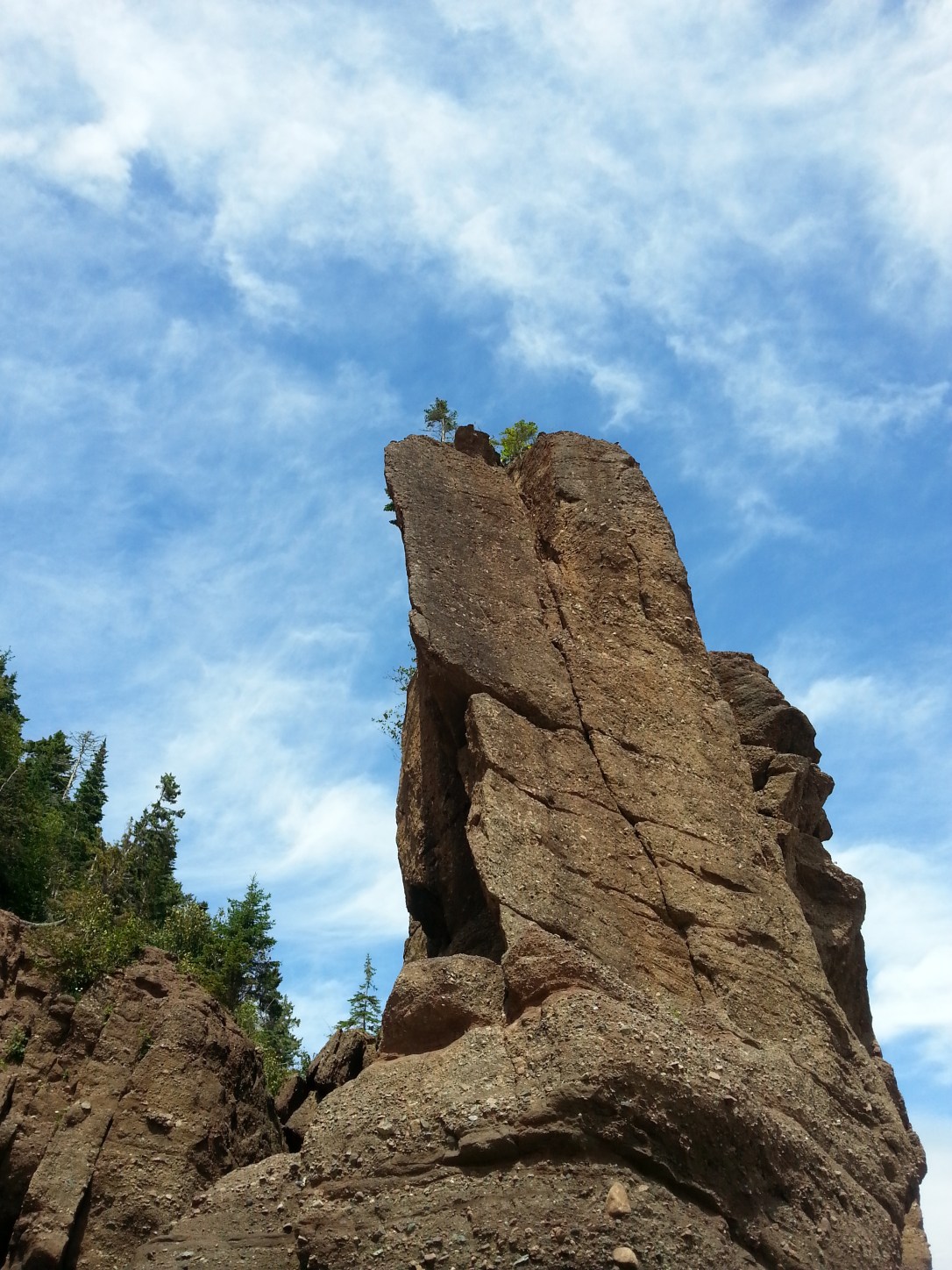
Last week we looked at the word sand (chol) and how Abraham was blessed by God to have descendants in abundance, like sand on the seashore. And where does sand come from?… it comes from rock:
Isaiah 51:1-2
Listen to Me, you who pursue righteousness, you who seek YHWH: Look to the Rock [tsur צ֣וּר] from which you were cut, and to the quarry from which you were hewn. Look to Abraham your father, and to Sarah who bore you. When I called him, he was but one; then I blessed him and multiplied him.
YHWH continued on to say:
Isaiah 51:4-5a
Pay attention to Me, My people, and listen to Me, My nation; for a law will go out from Me, and My justice will become a light to the nations; I will bring it about quickly. My righteousness draws near, My Salvation is on the way, and My arms will bring justice to the nations.
We, like sand, are the children of God, and God is our Rock and our Redeemer. He promised that Salvation was on the way.
These words Rock, Redeemer, Refuge and Salvation are intertwined all throughout the Tanakh. It has strong Messianic connotations. God promised a Messiah to be a Redeemer and to bring Salvation to the people. Let’s take a look at how the Hebrew Scriptures associate the future Messiah with Rock, Redeemer and Salvation.
First Rock in the Tanakh: Rock & Nourishment
The first time we see the word rock in the Tanakh (Old Testament) was during the exodus of the Hebrew people when they left Egypt and headed towards the promised land:
Exodus 17:3-6
But the people thirsted for water there, and they grumbled against Moses: “Why have you brought us out of Egypt—to kill us and our children and livestock with thirst?”
Then Moses cried out to YHWH, “What should I do with these people? A little more and they will stone me!”
YHWH answered Moses, “Walk on ahead of the people and take some of the elders of Israel with you. Take along in your hand the staff with which you struck the Nile, and go. Behold, I will stand there before you by the rock [ha-tsur הַצּוּר֮] at Horeb; when you strike the rock [va-tsur בַצּ֗וּר], water will come out of it for the people to drink.”
When Jesus made the claim that He was the Living Water (John 4:4-26, John 7:37-39) it harkened back to this moment in the Torah. Paul made that very clear in his letter to the Corinthians:
1 Corinthians 10:1-4
I do not want you to be unaware, brothers, that our forefathers were all under the cloud, and that they all passed through the sea. They were all baptized into Moses in the cloud and in the sea. They all ate the same spiritual food and drank the same spiritual drink; for they drank from the spiritual rock that accompanied them, and that rock was Messiah [Christ].
Some Biblical scholars also associated this moment, of Moses striking the rock, with the time when Yeshua (Jesus) was on the cross and His side was pierced. John noted that it wasn’t just blood that spilled out:
John 19:31-34
Now it was the day of Preparation, and the next day was to be a special Sabbath. Because the Jewish leaders did not want the bodies left on the crosses during the Sabbath, they asked Pilate to have the legs broken and the bodies taken down. The soldiers therefore came and broke the legs of the first man who had been crucified with Jesus, and then those of the other. But when they came to Jesus and found that he was already dead, they did not break his legs. Instead, one of the soldiers pierced Jesus’ side with a spear, bringing a sudden flow of blood and water.
Yeshua was the Rock from which the water flowed. This tied in to the Messianic prophecy written by the prophet Zechariah:
Zechariah 12:10
Then I will pour out on the house of David and on the residents of Jerusalem a spirit of grace and prayer, and they will look on Me, the One they have pierced. They will mourn for Him as one mourns an only child, and weep bitterly for Him as one grieves a firstborn son.
Rock, Living Water, Redeemer… when Jesus was struck, blood and water poured out. Jesus wasn’t just a metaphor; he lived out the metaphor, in the most painful way possible. Jesus even associated himself as the Rock when he told the parable about building your house on sand or on rock. Who was the wiser person? It was the person who built their future on the Rock (Matthew 7:24-29).
YHWH is the foundation upon which we build our future. There was a lot going on when Yeshua said to Simon Peter, “I also say to you that you are Peter [Greek: Petros], and upon this rock [Greek: petra] I will build My church; and the gates of Hades will not overpower it” (Matthew 16:18).
As image bearers of YHWH we are to become the solid foundations of this world, showing what it means to be rock-solid followers of the God of all Creation. We are to be providers of the water and bread of life, even in the worst of places (such as the frightening location of Caesarea Philippi, where Yeshua hinted to Peter that he would live up to his name.
By the way, Cephas is another Greek word for Rock. When Yeshua met Peter for the first time, in John’s Gospel account, Yeshua called him Cephas (Rock) (John 1:42). In Matthew’s account at the pagan worship centre of Pan in Caesarea Philippi, Yeshua changed Simon’s pet-name from Cephas to Petros (both Greek words for Rock), using word-play to make His point. If we are to bear His image then we are also to be rocks of salvation, bringing other people into the story of redemption… even in the darkest of places.
Second Rock in the Tanakh: Rock of Protection & Refuge
The second time rock makes an appearance in the Tanakh was, again, during a conversation between Moses and God. Moses boldly asked God to reveal His glory to him. God agreed to the request but told Moses that although He would pass in front of him he would not see His face (for no one could see God’s face and live):
Exodus 33:21-23
YHWH continued, “There is a place near Me where you are to stand upon the rock [ha-tsur הַצּֽוּר], and when My glory passes by, I will put you in a cleft of the rock [ha-tsur הַצּ֑וּר] and cover you with My hand until I have passed by. Then I will take My hand away, and you will see My back; but My face must not be seen.”
God used a rock for Moses to stand upon and a cleft in the rock to protect him. Rock was almost always associated with protection and refuge in the Bible:
Psalm 62:5-8
Rest in God alone, O my soul, for my hope comes from Him. He alone is my Rock [tsuri צ֭וּרִי] and my Salvation; He is my fortress, I will not be shaken. My Salvation and my honour rest on God, my strong Rock [tsuri צ֭וּרִי]; my refuge is in God. Trust in Him at all times, O people; pour out your hearts before Him. God is our refuge.
Salvation Rock Songs
It was the Song of Moses that really sets the descriptive name of God as The Rock in motion. Moses sang:
Deuteronomy 32:3-4, 15-18, 28-31a, 36-9
For I will proclaim the name of YHWH. Ascribe greatness to our God, the Rock [ha-tsur הַצּוּר֙]. His work is perfect; all His ways are just. A God of faithfulness without injustice, righteous and upright is He…
…But Jeshurun [poetic name for the Hebrew people] grew fat and kicked— becoming fat, bloated, and gorged. He abandoned the God who made him and scorned the Rock of his Salvation [Tsur Y’shua’tow צ֥וּר יְשֻׁעָתֹֽו].
They provoked His jealousy with foreign gods; they enraged Him with abominations. They sacrificed to demons, not to God, to gods they had not known, to newly arrived gods, which your fathers did not fear.
You ignored the Rock [tsur צ֥וּר] who brought you forth; you forgot the God who gave you birth…
…“For they are a nation destitute of counsel, and there is no understanding in them. If only they were wise and they understood this; if only they would discern their future!
How could one chase a thousand, and two put ten thousand to flight, unless their rock [tsurim צוּרָ֣ם] had sold them, and YHWH had given them up? Indeed, their rock tsuram צוּרָ֑ם] is not like our Rock [lo k-tsurenu לֹ֥א כְצוּרֵ֖נוּ]…
…For YHWH will judge His people and have compassion on His servants when He sees that their strength is gone and no one remains, slave or free. He will say:
Where are their gods, the rock [tsur צ֖וּר] in which they took refuge, which ate the fat of their sacrifices and drank the wine of their drink offerings? Let them rise up and help you; let them give you shelter! See now that I Am He; there is no God besides Me. I bring death and I give life; I wound and I heal, and there is no one who can deliver from My hand.
After Moses’s Song, God’s descriptor name of Rock was used in many of the great songs of the Old Testament (Tanakh).
Hannah sang:
1 Samuel 2:2
“My heart rejoices in YHWH; my horn is exalted in YHWH, my mouth speaks boldly against my enemies, because I rejoice in Your salvation.
There is no one holy like YHWH, indeed, there is no one besides You, and there is no rock like our God [w-en tsur kelohenu וְאֵ֥ין צ֖וּר כֵּאלֹהֵֽינוּ].”
David sang:
2 Samuel 22:3a
God is my Rock [Elohey Tsuri אֱלֹהֵ֥י צוּרִ֖י], in whom I take refuge, my shield, and the horn of my salvation. My stronghold, my refuge, and my Saviour..
The Hebrew Bible, the word rock appeared seventy-seven times, twenty-five of those were in the Psalms… showing up, really, as a key word that almost always referred to YHWH.
A Psalm of Asaph:
Psalm 73:23-26
Yet I am always with You; You hold my right hand. You guide me with Your counsel, and later receive me in glory.
Whom have I in heaven but You? And on earth I desire no one besides You. My flesh and my heart may fail, but God is the Rock of my heart [tsur l’vavi צוּר־לְבָבִ֥י] and my portion forever.
This verse is actually one of the most mis-translated spots in the Bible. Almost every English translation (check yours) uses the phrase strength of my heart, rather than rock of my heart. Although “strength” gets the point across, there is something more beautiful and poetic going on. Associating refuge, redeemer and saviour with the word rock tells us that God is the refuge of our heart, the redeemer of our heart and the Saviour of our heart… and that’s way more powerful than strength alone.
Rocking it together: Nourishment, Protection, Salvation
Probably the richest exploration of the word Rock comes from Psalm 78, which has also been attributed to Asaph. It harkens back to the earliest mention of rock, when God instructed Moses to pierce the rock which brought forth water for the people to drink:
Psalm 78:15-22, 35-39
He split the rocks [tsurim צֻ֭רִים] in the wilderness and gave them drink as abundant as the seas. He brought streams from the stone and made water flow down like rivers.
But they continued to sin against Him, rebelling in the desert against the Most High. They willfully tested God by demanding the food they craved. They spoke against God, saying,
“Can God really prepare a table in the wilderness? When He struck a rock [tsur צ֨וּר], water [mayim] gushed out and torrents overflowed. But can He also give bread [lechem] or supply His people with meat?”
Therefore YHWH heard and was full of wrath; so a fire was kindled against Jacob, and His anger flared against Israel because they did not believe God or rely on His Salvation [b’Yeshua-tow]…
…And they remembered that God was their Rock [Elohim tsur-am צוּרָ֑ם], that God Most High was their Redeemer. But they deceived Him with their mouths, and lied to Him with their tongues. Their hearts were disloyal to Him, and they were unfaithful to His Covenant.
Yet He was compassionate; He forgave their iniquity and did not destroy them. He often restrained His anger and did not unleash His full wrath. He remembered that they were but flesh, a passing breeze that does not return.
YHWH offered living water to the Israelites, but they did not rely on His Salvation. They said, yes you gave us water. But what about bread? God saw this as narrow-minded, and untrusting! If they had trusted and waited they would have discovered that yes, they would receive living water and the bread of life from YHWH, through the promised Messiah, God’s Anointed One.
It is no coincidence that the word Salvation, in Hebrew, is Yeshua, the Hebrew name of Jesus. Psalm 78 really is a very beautiful passage full of Messianic symbolism. Jesus was the pierced Rock from which would flow living water and He was the bread of life which, through his death, would be the Salvation of all of us.
In Matthew’s account, after Yeshua took His final breath the rocks split as the earth quaked.
Matthew 27:50-51
And Jesus cried out again with a loud voice, and gave up His spirit. And behold, the veil of the temple was torn in two from top to bottom; and the earth shook and the rocks [Greek: petrai] were split.
It was a striking picture. The earth trembled at what had just occurred and, symbolically, the Rock of our Salvation took a blow that separated the symmetry between Yeshua and His Father, YHWH. Death separated them as Yeshua went to the grave, but the Rock would not fall. Yeshua would rise up, defeat death, and be reunited with His Father in the eternal Kingdom, and as a result, our entrance fee back into the Edenic Kingdom has been paid for.
The Bible used the word Rock to tell us that we have the strongest and mightiest protection in YHWH. He not only provides and protects, but he also Saves! He is an immoveable Rock… our Refuge, our Redeemer, our Saviour. Let this be our prayer:
Psalm 18:46
YHWH lives! Blessed be my Rock! And may the God of my Salvation be exalted!
Kha YHWH! U-baruk Tsuri! Wey-yarum Eloheh Yishi!
Next week: Flower

 Hebrew Word Lessons
Just what I was looking for. Thank you!
LikeLike
Glad to be of help! 🙂
LikeLike