

We’ve been following Paul’s story since September and today we conclude with his final days of ministry. Last week, if you recall, Paul had arrived in Italy and made his way up to Rome. That journey is outlined in the very last chapter of Acts:
Acts 28:16
When we entered Rome, Paul was allowed to stay by himself, with the soldier who was guarding him.
Paul was under house arrest. He relied on his friends to bring him food and clothing, parchment and writing utensils. We know that Paul had a good community of supporters in Rome. His letter that he wrote to the church in Rome gave the names of many of his allies, including at least 10 women who were instrumental in Paul’s ministry.
Today we don’t have time to read the end of Acts, so I encourage you to read it this week. There you can find his final recorded message to the Jews in Rome, where he says:
Acts 28:20
I requested to see you and to speak with you, since I am wearing this chain for the sake of the hope of Israel.
Paul’s story, in chains, ends rather abruptly. His final message closes the book of Acts and we really don’t know what happened next for Paul. Here’s the final sentence of the book:
Acts 28:30-31
Now Paul stayed two full years in his own rented lodging and welcomed all who came to him, preaching the kingdom of God and teaching things about the Lord Jesus Christ with all openness, unhindered.
The book ends with Paul under house arrest, awaiting trial. f you recall, Paul refused to go back to Jerusalem and instead insisted on facing Caesar. Caesar, at the time, was the Emperor Nero… notorious for his cruelty. Did Paul ever face Nero? There is no record of his trail, but his second letter to Timothy gives us a hint. Paul says:
2 Timothy 4:16-18
At my first defense no one supported me, but all deserted me; may it not be counted against them. But the Lord stood with me and strengthened me, so that through me the proclamation might be fully accomplished, and that all the Gentiles might hear; and I was rescued out of the lion’s mouth. The Lord will rescue me from every evil deed, and will bring me safely to His heavenly kingdom; to Him be the glory forever and ever. Amen.
We know that around the time of Paul’s trial, the Great Fire of Rome occurred. It was a nine day fire, which started on July 18th, 64 AD and it decimated the city.
After the fire, Emperor Nero needed something to take the pressure off of him. The people of Rome were angry and ready to blame Nero, so Nero quickly flipped the narrative and placed the blame on Christians. It was Christians, he said, that lit the fire. People were already suspicious of these Christ-followers who denied the gods and so it was an easy sell. Nero capitalized on that and swiftly took action against Christians by torturing and executing them in mass numbers to support the claim that they were the arsonists. He crucified many, but he also ordered some of them to be doused in pitch and set on fire to be human torches in his garden. Others he exposed to wild dogs and lions in the Circus Maximus.
The question is: did Paul face these terrors in the arena? In the passage we read earlier Paul said, “I was rescued out of the lion’s mouth”… did he mean Nero? Or an actual lion? How horrific is it that both of these options are very real possibilities in first century Rome?!
What I can tell you, is that Paul never stepped foot in the Colosseum in Rome. We know that because the Colosseum was part of the rebuild after the fire. Construction began a year or two after Paul was executed. But that doesn’t mean Paul never faced the wild beasts in an arena setting. During Nero’s persecution, and even before the targeted attack, the Circus Maximus was used to place Christians against wild beasts, as a sick form of entertainment. Paul may have been a survivor of one of these horrific spectacles on an arena floor ten years earlier in Ephesus:
1 Corinthians 15:32
“I fought with beasts at Ephesus. If I did it for human motives, what did I gain?”
So, there’s a good chance he was thrown into an arena-setting to face wild animals in Ephesus. However, some scholars say he fought “metaphorical” beasts, basically saying that the people of Ephesus were like wild beasts to him. Whether these were real or metaphorical beasts, Paul gives us his first hand knowledge of what it felt like to be a spectacle of the Roman world. To the church in Corinth he writes:
1 Corinthians 4:9, 11-13
For I think, God has exhibited us, the apostles, last of all as humans condemned to death, because we have become a spectacle to the world, both to angels and to mankind… …Up to this present hour we are both hungry and thirsty, and are poorly clothed and roughly treated and homeless; and we labour, working with our own hands;
When we are verbally abused, we bless; when we are persecuted, we endure it; when we are slandered, we reply as friends; we have become as the scum of the world, the dregs of all things, even until now.
The entire Roman society was a terrifying arena that the Christian communities had to live in. Long before the Great Fire in Rome, Christians were attacked, mocked, and tortured. Nero just ramped up already existing persecutions and Paul (and Peter by the way) found themselves in Rome at the centre of the worst years of persecution, brought on by Nero.
It is believed that Peter was executed 3 months after the fire, in October 64AD. He was crucified upside down in the area now known as Saint Peter’s Square, Vatican City.
Paul, because he was a Roman citizen, was not crucified (that was generally reserved for foreigners). Instead, he was likely beheaded sometime between 64-67AD.
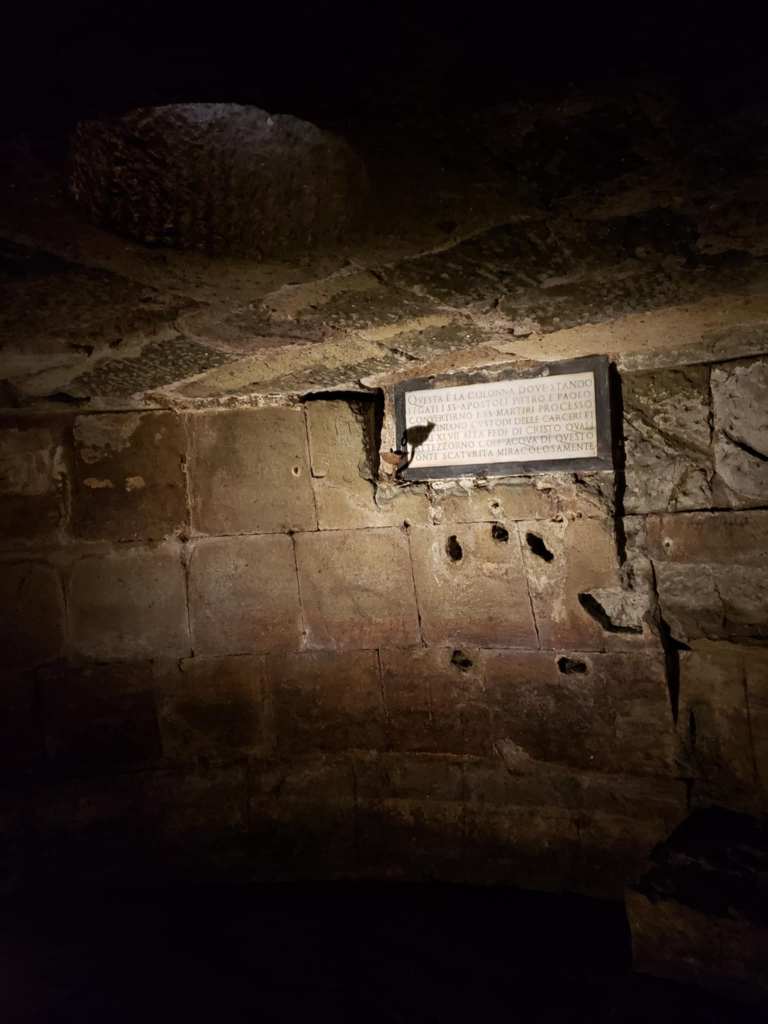
Months before their executions Peter and Paul were likely placed in the prison that held inmates awaiting execution: the Mamertine Prison. However, they were not likely there at the same time. Today a church sits on top of the site and stairs lead down to the underground cell.
The Mamertine Prison was a notorious dark, damp, dungeon. Prisoners were dropped into the darkness from the small hole in the ceiling. Paul’s only hope was for friends and allies to bring him food and warm, dry, clothing and bedding.
I had the opportunity to visit to the Mamertine prison and stand in this cell where Paul (and earlier, Peter) may have ended their days, chained to the wall. It was a surreal (and kind of heartbreaking) experience to be honest.
It was in this cell that Paul, quite possibly, crafted his final letter, which most scholars agree is 2nd Timothy. It would have been too dark to compose a letter and we know that Paul’s eyesight was not great at the best of times, so it’s possible he spoke the words and someone, like Luke, would have recorded his message through the hole in the ceiling.
With that in mind, I’d like to read part of the final chapter of his final letter where we’ll get a sense of Paul’s frame of mind as he sat in the dark and awaited his death:
2 Timothy 4:6-8
For I am already being poured out as a drink offering, and the time of my departure has come. I have fought the good fight, I have finished the course, I have kept the faith; in the future there is reserved for me the crown of righteousness, which the Lord, the righteous Judge, will award to me on that day; and not only to me, but also to all who have loved His appearing.
In one of the darkest spots on earth, Paul has this beautiful revelation of hope. He says, I have kept the faith and I will be rewarded… as will all who hold on to the love of God.
Spiritually Paul is unwavering, but this letter shows us that Paul is not doing well physically or mentally. He is cold, and hungry, and miserable and filled with sorrow over those who have abandoned him. As a result, his sentences are short, jarring, and distracted. He says:
2 Timothy 4:9-15
Make every effort to come to me soon; for Demas, having loved this present world, has deserted me and gone to Thessalonica; Crescens has gone to Galatia, Titus to Dalmatia. Only Luke is with me.
Take along Mark and bring him with you, for he is useful to me for service. But I have sent Tychicus to Ephesus. When you come, bring the overcoat which I left at Troas with Carpus, and the books, especially the parchments. Alexander the coppersmith did me great harm; the Lord will repay him according to his deeds. Be on guard against him yourself too, for he vigorously opposed our teaching.
Paul, who is normally so eloquent, is a little bit all over the place… his thought process is jumbled: bring Mark, Tychicus went to Ephesus. I need my overcoat, books and parchments. Watch out for Alexander the Coppersmith. Then he jumps back to the passage we read earlier and speaks with clarity:
2 Timothy 4:16-18
At my first defense no one supported me, but all deserted me; may it not be counted against them. But the Lord stood with me and strengthened me, so that through me the proclamation might be fully accomplished, and that all the Gentiles might hear; and I was rescued out of the lion’s mouth. The Lord will rescue me from every evil deed, and will bring me safely to His heavenly kingdom; to Him be the glory forever and ever. Amen.
Paul lays out his beautiful hope for all to see: “The Lord will Rescue me… and bring me safely to His heavenly Kingdom”. This hope is why Paul is so willing to suffer, day after day. But from there Paul falls back into a jumbled train of thought:
2 Timothy 4:19-22
Greet Prisca and Aquila, and the household of Onesiphorus. Erastus remained at Corinth, but I left Trophimus sick at Miletus. Make every effort to come before winter. Eubulus greets you, also Pudens, Linus, Claudia, and all the brothers and sisters. The Lord be with your spirit. Grace be with you.
The end. That’s it. Those are likely the final words we have from Paul. Not long after these words were recorded, Paul was very likely beheaded outside the walls of Rome.
Shortly after Paul died, Nero committed suicide. Sadly, though, that did not end the persecution of Christians. The newly built Colosseum thrived on the spectacle of torturing Christians for a ravenous audience.
This is the historical heritage of our faith. The Christian faith was built upon martyrs and slaves of the ancient world under the dominion of Rome. They were the marginalized people of faith and we ought to remember those humble beginnings.
Because of our heritage, we should be the first to stand up for those who suffer persecution in our lifetime. Victims of human trafficking, people experiencing adverse poverty, refugees, orphans, prison inmates, the abused, the neglected… we ought to be their champions!
If we don’t stand up and show our community that we care for them… Christianity will be considered irrelevant to their lives. I think we need to have a brainstorming session to figure out what we can do, in this community, to show that we are willing to stand alongside the suffering and the needy. It’s something I think we ought to be praying about.
So this concludes our travels with Paul… what a legacy. My hope is that by knowing a bit more about the time and the places where Paul lived, you will have a refreshed set of eyes when you read his letters.
Paul was a man that suffered a great deal… but he had unwavering faith that all the suffering he experienced was worth the reward. He truly believed that Jesus FREED us from our suffering and He’s freed us from any guilt that we’ve laid upon ourselves. To the church in Galatia, Paul said:
Galatians 5:1
It was for freedom that Christ set us free; therefore keep standing firm and do not be subject again to a yoke of slavery.
Do not enslave yourselves to the evils of this world. Stand up and say, “no”. We need to stand up for ourselves, but just as important, we need to stand up for others who are lost in this world.
Last week we sang a song that I think would reflect Paul’s feeling as he laid his head on the chopping block and took his final breath…
I have freedom, I have freedom, thank you Jesus, I am free.
No more chains on me, now in Christ I live, thank you Jeus, I am free.

 Hebrew Word Lessons