

So we’ve been following Paul’s trail for awhile now, and we’re going to wrap up this week and next week with Paul’s final five years on the planet, around the years 60-65 AD… which means we are going to be in Italy for the next two weeks, which is thematic, considering the Olympics are currently going on in Italy for the next few weeks. See how this is all working out? Add some Italian food and we can all pretend we’re right there under the warm sun of the Mediterranean… just don’t look outside.
Now when we last followed Paul, he was in Malta where they stayed for three months before finally getting on a ship and heading to Rome.
Acts 28:11
[Luke:] After three months we set sail on an Alexandrian ship which had wintered at the island, and which had the Twin Brothers for its figurehead.
Who were the “twin brothers?” They were Castor and Pollux, patron gods of the sailors and highly revered in Rome. Paul and Luke were on their way to Imperial Rome… and the figurehead on the ship would have been a daily reminder that they were going into the belly of the beast. Caesar was in Rome and Caesar wasn’t all that keen on Christians.
But before they could get to Rome they made a few stops along the way:
Acts 28:12-15
After we put in at Syracuse [in Sicily], we stayed there for three days. From there we sailed around and arrived at Rhegium, and a day later a south wind came up, and on the second day we came to Puteoli. There we found some brothers and sisters, and were invited to stay with them for seven days; and that is how we came to Rome. And from there the brothers and sisters, when they heard about us, came as far as the Market of Appius and the Three Inns to meet us; and when Paul saw them, he thanked God and took courage.
So before they got to Rome they stopped and stayed at Puteoli… where they met up with fellow Christians, which was a great comfort to Paul.
It’s interesting that Christianity reached Italy long before Paul arrived. How did that happen?
We often think that Paul brought Christianity wherever he went, but for the most part, it was already there. Paul just nurtured the church that was already active. With the exception of Malta, most places already had established Christian communities. Paul just flamed the spark.
How is it, though, that Christianity got to places like Italy long before Paul ever arrived?
We are told in Acts 2:41 that during the event of Pentecost 3000 people witnessed and experienced an amazing supernatural event. It shook them to the core and they all left Jerusalem with a conviction that the Spirit of God had been given to them to change the world. Those 3000 people went home, wherever home was, and spread the message across the known world. They laid the foundation for people like Paul and Peter and Priscilla and Barnabus and Phoebe and Luke to help spread the Good News and nurture the growing communities of Jesus followers.
So when Paul and Luke got to Puteoli they were greeted by men and women of the faith who supported them (we’re told) for seven days. Paul, if you recall, was still under arrest, so he would have been accompanied by a Roman guard… but he was still allowed to see his friends.
It’s important to note that being a prisoner of Rome was a death sentence if you didn’t have friends or family to support you. Unlike jails today, in Rome they didn’t feed you or provide any necessities. You had to rely on friends and family to give you what you needed to survive in jail… food, clothing, bedding- it was up to you to get these things. This is probably why Luke went along for the ride. He would be the outside person who would make sure that Paul wasn’t abandoned and left to starve to death under lock and key.
We read that when they met other Christians on their way to Rome, Paul was given “courage”. It told him that there was a community of support that he could rely on… and the weight of it all wouldn’t rest solely on Luke. With a team of supporters, Paul could eat and continue his ministry. People would supply Paul with not just food, but all that he would need to continue his ministry through letter writing… paper and ink and messengers to deliver correspondence around the Mediterranean.
Now the seven day stop in Puteoli placed Paul not far from the great Mount Vesuvius. In 79AD, fourteen years after Paul’s death, Mount Vesuvius would erupt, fatally decimating two towns: Pompeii and Herculaneum. Herculaneum was one of the spots we visited this summer. Pompeii, the more famous of the two towns, was destroyed by large falling rocks, debris, and pyroclastic surges (hot gas and ashes which would immediately kill upon contact); Herculaneum, on the other side of the mountain from Pompeii, was spared from massive falling rocks but was wiped out by these pyroclastic surges and completely buried in ash. This means that more of the town survived intact. There are complete two story buildings from the time of Paul still standing in Herculaneum, with incredible artwork that still maintains its original colours.
Paul and Luke landed in Puteoli, just 30km away from Herculaneum, around 59-60AD… twenty years before the volcanic tragedy.
In the 1930s archaeologists in Herculaneum discovered a small servants-quarters room at the back of a residence. In the centre of the wall there was an indentation of what appeared to be a cross in a plastered rectangle. Skeptics argue that this is just an outline of a shelving bracket but when we were there, our tour guide was convinced that this was truly a Christian cross hidden in one of the slaves quarters. Indications of Christianity weren’t just found in Herculaneum. Theologian, Bruce Longenecker, wrote a book titled,“The Crosses of Pompeii: Jesus-Devotion in a Vesuvian Town” which points out the many crosses found in Pompeii in engravings on sidewalks and inscriptions on walls. There is a very good chance that there were Christians in Herculaneum and Pompeii at the time of the volcanic eruption. Paul’s presence in the area, a mere 20 years earlier, would have been very encouraging to the local underground Christian community of that time. Christianity was not yet universally accepted in pagan Rome, in fact it was illegal, so at the time of the eruption, in 79AD, most adherents to the Christian faith would have hid in secret.
Christians were persecuted, many finding themselves in the great Arenas and Colosseums facing lions and violent executioners. The Herculaneum cross had nails on either side of it, meaning something may have hung there to cover the cross and keep it hidden. It’s a stark reminder of the dangers early Christians faced in the harsh age of dominating Roman power.
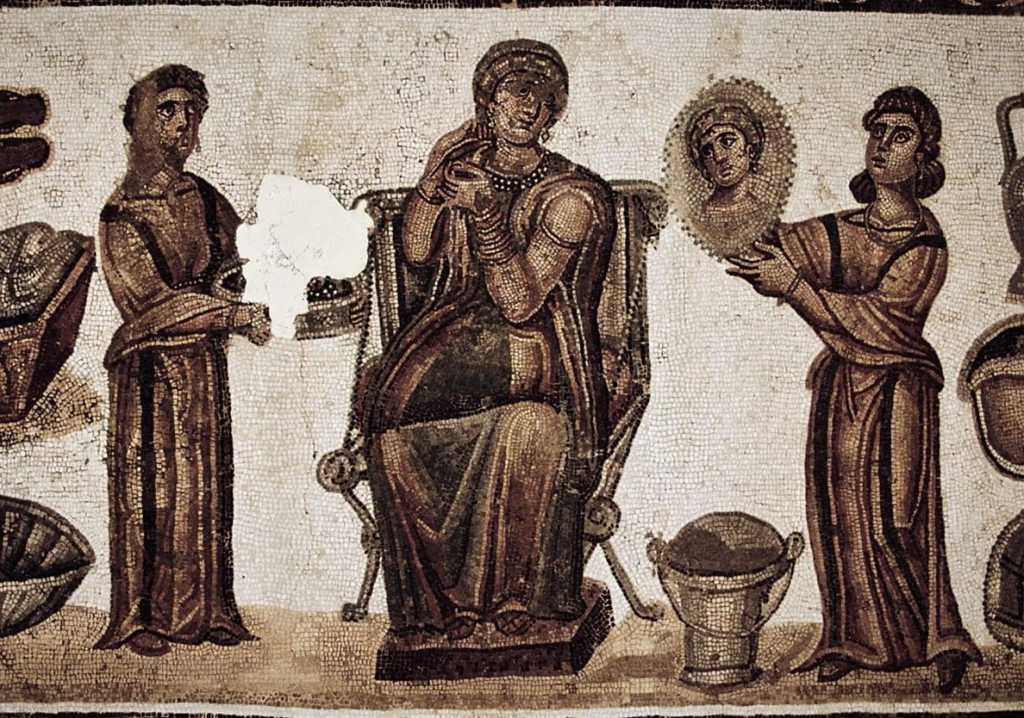
So who were these early Christians of Italy? There wasn’t much incentive for the wealthy ancient Romans to become Christians. They had lived privileged lives. The gods they worshipped seemed to favour them, so why would they abandon their pantheistic faith when it seemed to give them a life of entitlement?
Where Christianity really gained its strength was from a group of people generally ignored by the wealthy and prosperous… the slaves.
Slaves would have found a great sense of freedom in the words of Jesus… such as:
Matthew 5:3
Blessed are the poor in Spirit for theirs is the Kingdom of Heaven.
Matthew 5:5
Blessed are the meek for they shall inherit the earth.
Roman servants would have also clung to the words of Paul when he announced:
Galatians 3:28
There is neither Jew nor Greek, slave nor free, male nor female, for you are all one in Christ Jesus.
Christianity boldly reported that slaves were equals to all other humans in the eyes of God. Their “so-called” Masters were no more important than they were. That was a radical shift of thought and it must have been very liberating for those who were born into slavery with no end in sight.
Now we have to be careful not to insert our own concept of slavery onto 1st century slavery. Try not to think of American slavery. Slavery in the Roman world had nothing to do with race or skin colour. Slaves could be any nationality, including a Roman who was in debt. In the Roman world slaves were either acquired through war-booty, or someone selling themselves into manual labour in order to pay off a debt. You could also gain new slaves when one of your servants gave birth to the next generation. It was also not uncommon to take in abandoned babies and raise them to become house servants.
In the ancient world slaves, or servants, could be beaten but not necessarily to the extent that we imagine in American slavery… because beating your servants meant you were damaging your “property” and your work force… which would be a costly loss of revenue. There’s also archaeological evidence that they were fairly well fed, in order to keep them content and able to work. That doesn’t mean they had an easy life. The male head of the house had full bodily access to the slaves of any age or gender. There was no right of refusal.
Although servants were considered to be the property of Roman citizens there were possible ways to buy their way out of servitude and acquire the freedom of Roman citizenship. So there was a glimmer of hope for slaves in the Roman world… but that didn’t make slavery any less horrible.
Paul had a lot to say about slavery. He felt that Christians should not hold anyone in submission because all humans were created to be equals in the eyes of God… Paul believed that things like social class, gender, nationality, race, and financial status, had no bearing on how God sees us. Everyone is made in the image of God and all were made to reflect God’s loving, merciful, image to the world.
For Paul, owning slaves was not compliant with the teachings of Jesus. In fact, he wrote an entire letter that addressed the issue of slavery. We know it as the book of Philemon although it was addressed to three people and their house church:
Philemon 1:1-7a, 18-19 (or letter to Philemon, Apphia, and Archippus)
Paul, a prisoner of Christ Jesus, and Timothy our brother,
To Philemon our beloved brother and fellow worker, and to Apphia our sister, and to Archippus our fellow soldier, and to the church in your house:
Grace to you and peace from God our Father and the Lord Jesus Christ. I thank my God always, making mention of you in my prayers, because I hear of your love and of the faith which you have toward the Lord Jesus and toward all the holy ones…
…Therefore, though I have enough confidence in Christ to order you to do what is proper, yet for love’s sake I rather appeal to you—since I am such a person as Paul, an old man, and now also a prisoner of Christ Jesus— I appeal to you for my son Onesimus, whom I fathered in my imprisonment, who previously was useless to you, but now is useful both to you and to me. I have sent him back to you in person, that is, sending my very heart, whom I wanted to keep with me, so that in your behalf he might be at my service in my imprisonment for the gospel; but I did not want to do anything without your consent, so that your goodness would not be, in effect, by compulsion, but of your own free will. For perhaps it was for this reason that he was separated from you for a while, that you would have him back forever, no longer as a slave, but more than a slave, a beloved brother, especially to me, but how much more to you, both in the flesh and in the Lord. If then you regard me as a partner, accept him as you would me. But if he has wronged you in any way or owes you anything, charge that to my account; I, Paul, have written this with my own hand, I will repay it…
Here is Paul doing his best to bear the image of God. He is saying, I will pay Onesimus’ debt to set him free from any financial obligation that keeps him in servitude. I will pay the ransom. I will redeem him. I must do this, if I’m to reflect what God looks like.
And so this is Paul’s plea to Philemon, Apphia and Archippus… that they release Onesimus from bondage so he could be a brother to them, and not a slave to them.
Philemon 1:21-25
…Having confidence in your obedience, I write to you, since I know that you will do even more than what I say. At the same time also prepare me a guest room, for I hope that through your prayers I will be given to you. Epaphras, my fellow prisoner in Christ Jesus, greets you, as do Mark, Aristarchus, Demas, and Luke, my fellow workers. The grace of the Lord Jesus Christ be with your spirit.
Paul was imprisoned, but he always held out hope that God had more for him to do. He was no servant of man, but he was God’s servant… always striving to do the will of God… always trying to look like Jesus in every situation. And that meant standing up for the meek and the needy, the widowed, the orphaned and the slave, like Onesimus.
As he and Luke, and others with them, marched across Italy, on their way to the great city of Rome, followers of Jesus sought them out and gave them courage and support. It’s a beautiful reminder that we’re all family… that we should all be supporting each other as we do our best to bear God’s image during our lifetime.
Today people are enslaved to many things… abusive relationships, addictions, finances.
Maybe big debts mean that you are forced to be a slave to money. Many of us feel oppressed, overworked, under-appreciated, overwhelmed. We look at these powerful people and feel very small and insignificant… and our self-esteem hits rock bottom.
If that happens to you, remember, YHWH calls you His “treasured possession” (segullah in Hebrew) (Malachi 3:17). He sees your incredible value. You are like a jewel in His crown… worthy to inherit His Kingdom on earth. Jesus said,
Luke 12:32
Do not be afraid, little flock, because your Father has chosen to give you the kingdom
We are the sons and daughters of YHWH, inheritors of all His creation. To God we are no less important than the big power-players that dominate the headlines. We may be little in stature, but we are great in value… and although we should be humble about it, we should also lift our heads up with confidence that comes with knowing that we are treasured by the Creator who made us and He has a plan and a place for us… and it is a good plan and a good place.
We are slaves to no one, but we are called to be servants of the living God, sharing His love and mercy and overwhelming kindness to EVERYone who seeks to drop the chains of worldly oppression and live truly free.
Paul was stuck in prison… and next week we’ll see what that meant for Paul in the capital of Rome under the dominion of Nero. It was a tough end for Paul. Although he was in chains, he lived life like he was the freest man on earth because he knew that Jesus had set him free, and the chains of man would not hold him down. So, I implore you, put your faith in Jesus, and you can experience that same freedom… no matter your circumstances.
Next week: SERMON- Paul in Rome

 Hebrew Word Lessons