

Paul in Malta
Today I’d like to go waaaay back in time to November 2025… when we were discussing Paul’s final years. I realize November feels like a century ago, but hopefully you can remember a little bit about what we discussed. But in case you don’t, here’s a recap: we last left Paul in the middle of a storm on the Mediterranean Sea, about to be shipwrecked on an Island. If you recall, Paul was a prisoner of the Roman Empire on his way to plead his case before Caesar in Rome. The ship left Israel and headed towards Crete. They were in tumultuous seas and barely made it to Crete but once they were there, despite Paul’s warnings, they decided to continue on. It was an “almost” fatal mistake. They landed themselves in the middle of a cyclone and it looked pretty dire. In fact the whole crew were ready to give up and die in the waves, but Paul announced that an angel had visited him and told him that everyone would live, but the ship would perish. And that is what happened. They crashed into an Island and all 276 passengers survived.
So, they’re on the ship, looking for a place to run ashore…
Acts 27:39-44, 28:1
Now when day came, they could not recognize the land; but they did notice a bay with a beach, and they resolved to run the ship onto it if they could. And casting off the anchors, they left them in the sea while at the same time they were loosening the ropes of the rudders; and they hoisted the foresail to the wind and were heading for the beach. But they struck a reef where two seas met and ran the ship aground; and the prow stuck firmly and remained immovable, while the stern started to break up due to the force of the waves. The soldiers’ plan was to kill the prisoners, so that none of them would swim away and escape; but the centurion, wanting to bring Paul safely through, kept them from accomplishing their intention, and commanded that those who could swim were to jump overboard first and get to land, and the rest were to follow, some on planks, and others on various things from the ship. And so it happened that they all were brought safely to land. When they had been brought safely through, then we found out that the island was called Malta.
These are the words of Luke, who was Paul’s travel companion at the time. We sometimes forget that Luke went through this shipwreck as well… he was tossed about by the waves, felt the hunger and exhaustion, and yet he never really complains about anything when he puts the story to paper. Interesting that he gives us a big glimpse of who Paul is, but doesn’t talk much about himself. He simply records the story in a way that almost makes us forget that he was there.
What Luke does make clear is that Paul doesn’t always get his way. And when he doesn’t, God uses the situation to show that good can still happen, even in adversity. Paul didn’t want to leave Crete. He knew the storm was too dangerous, but he was out-voted. He was right; they shouldn’t have left. But, had they not left, an entire Island would have been bypassed. The divine rescue by the shores of Malta, means that an entire Island of people who had no connection to Christianity would hear the Good News. The gospel would be presented to an Island that Paul had no plans to reach. As far as we know, it wasn’t on his radar, and this is a guy who was a super-planner who wanted to reach the known world. Luke tells us that they discovered the name of the Island only after they arrived and, presumably, talked to the natives who lived there. So this Island wasn’t on Paul’s list of places to get to. But it was on God’s list.
Once they’ve landed on the Island they were greeted with a nice surprise…
Acts 28:2-3
The natives showed us extraordinary kindness, for they kindled a fire and took us all in because of the rain that had started and because of the cold.
Can you imagine how miserable they must have felt? They had been tossed around on the waves for days. They would be wet, cold, dizzy, hungry, and exhausted. And when they finally get onto land, it’s raining… and it’s cold. Thank goodness for the kindness of strangers who made it a little more bearable. These Islanders build a fire for the survivors to be warmed by, and Paul, who was never one to sit still, helped gather sticks for the fire…
Acts 28:2-3
But when Paul had gathered a bundle of sticks and laid them on the fire, a viper came out because of the heat and fastened itself on his hand. When the natives saw the creature hanging from his hand, they began saying to one another, “Undoubtedly this man is a murderer, and though he has been saved from the sea, justice has not allowed him to live.”
Malta, during Paul’s day, was a culture that believed in checks and balances. This is the concept of karma. Karma is a Buddhist principle where, according to this definition, “intentional actions reliably produce matching consequences.”
So if you’re a liar, people will regard you as untrustworthy. If you’re generous, you will be paid back with a wealth of opportunities. In other words, if you do good, good will come upon you. If you do bad, bad will come upon you. You may be able to dodge the bad here and there, but eventually it finds you and pays you back, in the end. So, if something bad happens to you… ultimately, you deserve it. If a tragedy happens in your life, somewhere in your story you did something to deserve that tragedy. So, you better make up for your bad past or it will catch up with you!
This is not how God works… and it should never be considered a core belief in Christianity. Yet somehow this idea that people will get what they deserve, in the end, has stuck around partly because we want it to. We want God to be the pay-back King. When we feel mistreated we find comfort in the idea that they’ll pay for it later, right?
The Bible gives us an entire book that teaches us that karma is not a Godly concept. Karma is not how God addresses justice. At all.
Do you recall the story? Job had a really excellent life and he was devoted to YHWH. But up in the Divine throne room of God, the Adversary (or Satan) addressed God and told him that Job only loved God because his life was good and easy. Take away all of the good things in Job’s life and he would no longer worship YHWH. Here’s Satan’s observation: We only love God for the benefits that He brings? Take those benefits away, and we’ll no longer love God. We’ll quickly forfeit our allegiance when things get tough. For many people, he’s not wrong. If we only praise God when things are good, then our theology is pretty shaky… and it probably won’t stand up for long… because we all go through hard times at one point or another. Prosperity is great, but if your faith is only good when good things happen to you, you’re going to fall apart pretty quickly when bad things happen… and they undoubtedly will. With such a tenuous faith, one misfortune can shake it… and maybe even destroy it.
So, unbeknownst to him, Job became the centre point of this cosmic question. The Adversary asked permission to prove his case that Job only loved God because his life was easy and prosperous. Take that away and Job would “curse God to His face”. YHWH agreed to the test, as long as Job wasn’t killed.
And so Job lost everything: his children, his home, all his property, and his health. The only thing he had to hold on to was his life in the sad state that it had become. That’s all that was left. He was at the lowest point of his existence.
Now Job’s friends kindly sat and grieved with him, but they couldn’t help but try to provide answers to his suffering. Job, they argued, must have done something to cause this tragedy. This must be karma for something that Job had done. Job, however, maintained his innocence. He knew he had done nothing wrong.
Knowing that he had done nothing wrong, and faced with the fact that this wasn’t karma, he came to only one conclusion: God must be the cause of his pain; God must get some sort of sick pleasure in watching human suffering. He says things like this:
Job 10:3
“Does it please You [God] to oppress me, to reject the work of Your hands and favour the schemes of the wicked?”
Job 16:11-13
“God hands me over to criminals, and tosses me into the hands of the wicked. I was at ease, but He shattered me, and He has grasped me by my neck and shaken me to pieces; He has also set me up as His target. His arrows surround me. He splits my kidneys open without mercy; He pours out my bile on the ground.”
Job 30:20-21
“I cry out to You for help, but You do not answer me; I stand up, and You turn Your attention against me. You have become cruel to me; with the strength of Your hand You persecute me.”
Let me be clear. God is never cruel. Job was trying to understand why bad things were happening to him. Karma wasn’t working right. Job was good, so why did such bad things happen to him? The only answer that he could come up with was that God was cruel. But Job was blaming the wrong supernatural being. He even says, in chapter 10, that God is like a lion trying to hunt him down and devour him. He’s got the wrong supernatural being… it’s the Adversary who hunts us down and wants to mess us up.
Now Job had no idea that God and Satan placed him in the middle of their test. The truth is, God had more faith in Job, than Job had in God. The one we call “Satan” (which literally means, “Adversary”) is the chaos bringer, and the cause of misfortune… not YHWH. You see, God doesn’t cause bad things to happen, but He can use them to further the Kingdom. The Satan thinks he’s doing so much damage to God and His followers, but God brings these chaotic moments under His control and then turns them into ways to support and enrich the Kingdom. It must drive Satan crazy… I am going to cause chaos! And then God uses the chaos to bring people back to Him, back to order. Unfortunately though, many people who go through hardship just blame God, because He’s an easy target.
Now eventually Job recognized that he was wrong about God and he repented, and now this book stands as a testament to God’s real role in our suffering. He is our rescuer and redeemer.
In many ways I think we like the concept of karma. We get upset because bad people often seem to prosper, while good people are faced with terrible tragedy. How is that fair? Sometimes all we can hold onto is the idea that there will be a final judgement… and then we think, ah that’s karma. But is God’s judgement karma? Yeshua said…
Matthew 5:3-5
“Blessed are the poor in spirit, for theirs is the kingdom of heaven. Blessed are those who mourn, for they will be comforted. Blessed are the meek, for they will inherit the earth”
According to karma they’re probably poor because they deserve it; they’re probably grieving because of the cost of their sin; they’re probably weak because they’ve done nothing to strengthen themselves. Yeshua says that the suffering ones will be blessed. But those who have everything they ever wanted… their blessings are in the here and now… and that’s a pretty temporary place.
Here’s the thing, according to Paul…
Romans 3:23-24
All have sinned and fall short of the glory of God, and are justified freely by His grace through the redemption that is in Christ Jesus.
We’ve all sinned. Maybe we’ve been jealous, or angry, or petty, or abusive in our language, or we’ve wished someone harm, or we’ve lied to get ahead. Thank God he’s not a proponent of karma. God is a god of redemption. What does that mean?
Whereas karma is a belief of checks and balances, God wiped out the balance and paid for it all by the sacrifice of Yeshua. He paid the entrance fee into God’s Kingdom so we can freely be in the presence of God… guilt free! Even though we don’t deserve it. However, God tells us we do deserve it, because our sins have been forgiven and paid for. This is not karma, this is real freedom.
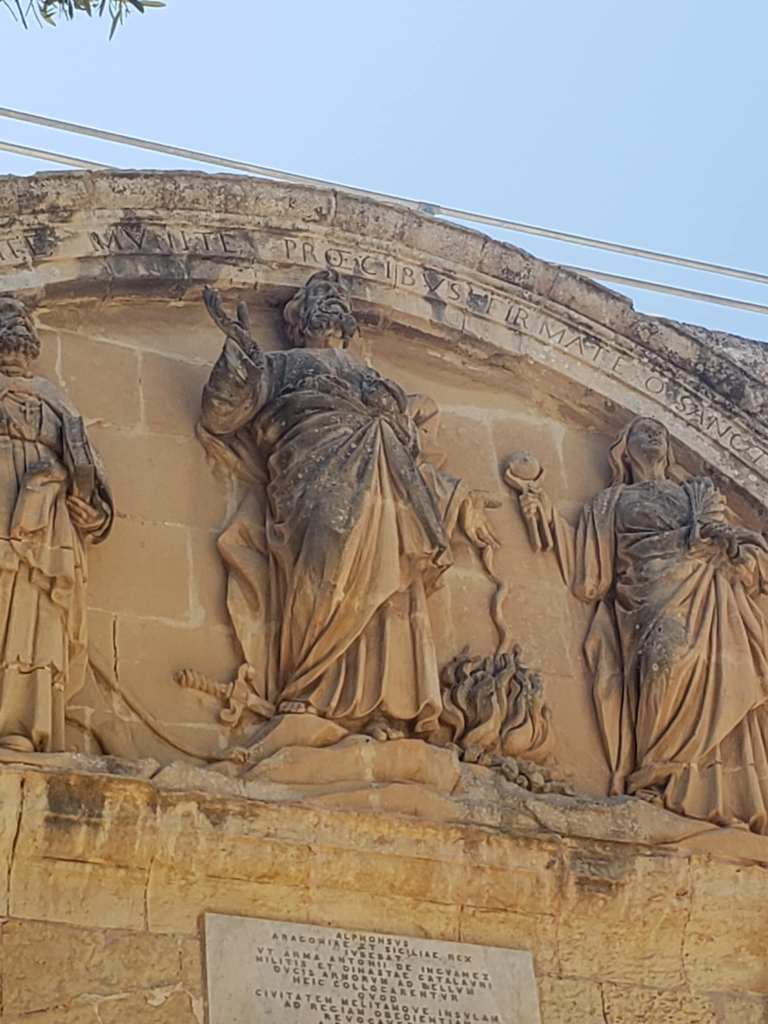
And so the people of Malta, big believers in the concept of karma, figure that this Roman prisoner, who survived a shipwreck only to be bitten by a snake, must be a bad guy… a murderer… one worthy of snake poison. But they were about to get a lesson in a new worldview:
Acts 28:5-6
However, Paul shook the creature off into the fire and suffered no harm. Now they were expecting that he was going to swell up or suddenly fall down dead. But after they had waited a long time and had seen nothing unusual happen to him, they changed their minds and began to say that he was a god.
Paul survived what would normally be a death sentence. He seemingly conquered death. To the Maltese people, he must be a god. What an opportunity for Paul. He can say, I’m not a god, but I am a child of a God who DID conquer death!
Now, this was not the first time Paul was thought to be a god. In Acts 14 you can read about a time when Paul & Barnabas were sharing the gospel with the people in Lystra. After they healed a lame man the people began to call Barnabas “Zeus” and Paul “Hermes”. Hermes was the clever messenger god who guided souls to the underworld. He was the god of travelers, trade, witty language. It’s not surprising they associated Paul with Hermes because Paul was a traveling, witty, public speaker who did some pretty miraculous things.
Now, both Barnabas and Paul emphatically denied any connection to godhood, saying…
Acts 14:15
“Men, why are you doing this? We too are only men, human, like you. We are bringing you good news that you should turn from these worthless things to the living God, who made heaven and earth and sea and everything in them.”
I suspect Paul would have said the same thing to the Maltese people. I am not a god, I merely bring you good news about the one and only true Living God who can conquer death. But since Luke already recorded Paul’s response in Lystra, he doesn’t feel the need to repeat the response here. Instead we read this:
Acts 28:7-9
Now in the neighbouring parts of that place were lands belonging to the leading man of the island, named Publius, who welcomed us and entertained us warmly for three days. And it happened that the father of Publius was lying in bed afflicted with a recurring fever and dysentery. Paul went in to see him, and after he prayed, he laid his hands on him and healed him. After this happened, the rest of the people on the island who had diseases were coming to him and being cured.
Here’s what’s interesting about Malta. They had an obsession with funerary culture and death. It appears that there was a pretty significant death cult in prehistoric Malta… and that would have carried on through all the way to Paul’s day. Malta houses some of the oldest free-standing temples on the planet… far older than the pyramids of Egypt or Stonehenge. These free-standing buildings were tied to death and burial chambers. By the way, for some perspective, Prince Edward Island is 18x LARGER than Malta! And yet Malta has at least 20 neolithic temples and burial chambers. We visited one of the underground burial chambers called the Ħal Saflieni Hypogeum which was a pretty cool place to visit.
They only allow 10 people an hour to enter the chamber so we had to purchase our tickets months in advance. It’s a subterranean tomb structure built, circa, 2500 BC… long before Paul arrived. The tomb has a central point, known as the Oracle Room, which was designed to have absolutely perfect acoustics. At just the right spot a low voice would resonate and send vibrations throughout the many chambers of the structure. This early sound engineering was probably used by priests or priestesses to produce low, creepy, sound that reverberated throughout the entire tomb during burial ceremonies.
So, the worldview of the indigenous peoples of Malta seems to be quite connected with death and the concept we know as “karma”. Paul would show them a new worldview… and although Luke doesn’t share any of Paul’s sermons to the Maltese people, he undoubtedly shared the Gospel… because he did that everywhere he went. Paul would have emphasised that Yeshua rose from death, and conquered it… because that would have a profound effect on the death-fearing people of Malta!
They feared death to the point that they worshiped it out of reverence. The news that death wouldn’t take them down, would have been a very freeing message indeed!
In fact, Christianity spread so quickly after Paul & Luke’s visit, that Malta would become one of Europe’s first Christian nations, and today it still holds Christianity as its state religion.
However, all we’re told is that Paul healed the sick in Malta, physically and spiritually. And he took three months to do it, and it reshaped Malta into an Island of believers. God led the ship to Malta for a reason (even though Paul wanted to stay in Crete), and everyone benefitted. Luke says…
Acts 28:10-11
They also showed us many honours, and when we were about to set sail, they supplied us with everything we needed. After three months we set sail on an Alexandrian ship which had wintered at the island, and which had the Twin Brothers for its figurehead.
So, they’re off to Italy, finally, which is where we’ll pick up in February, when we’ll answer the question: who are the “Twin Brothers”…amongst other things. Until then, let’s remember this: Your faith is not about checks and balances. And if, and when, you go through suffering… it’s not because you deserve it and it’s not because God is punishing you. It’s because we live in a world where the Adversary is making a big mess and we feel the effects of it, but it cannot conquer us.
We will suffer, we will grieve, we will feel meek and weak, we will feel poor in spirit… but ours is the Kingdom of Heaven and one day, when God will put everything back in order, when He cleans up the big chaotic mess left by the Adversary, we will inherit the earth as God intended it to be!
The judgement is our choice: embrace God’s goodness and seek His face. Or reject Him. It’s not about being good or bad, it’s about having an honest and genuine relationship with the God who created you and loves you. It’s not karma, folks, it’s freedom! And it’s yours for the taking!
Next week: Discernment

 Hebrew Word Lessons
This is very good and eye-opening! Thank you!
LikeLike