

Good morning folks. This morning we’re going to continue on our travels with Paul, because I think it’s worth getting to know the guy who wrote 24% of the New Testament. N.T. Wright, a prominent New Testament scholar, wrote “Paul: a Biography”, and in it he says this:
“When people in churches today discuss Paul and his letters, they often think only of the man of ideas who dealt with lofty and difficult concepts… We easily forget that the author of these letters spent most of his waking hours with his sleeves rolled up, doing hard physical work in a hot climate, and that perhaps two-thirds of the conversations he had with people about Jesus and the gospel were conducted not in a place of worship or study, not even in a private home, but in a small, cramped workshop. Saul had his feet on the ground, and his hands were hardened with labour. But his head still buzzed with scripture and the news about Jesus.”
If you recall, a few weeks back, we talked about Paul’s time in Athens. Athens was a city that would have been rather comfortable for Paul. It was full of scholars and debaters. They were curious about Paul and were interested in what he had to say. It would have been an easy place for Paul to stay, but he didn’t. He preferred to carry on towards far less inviting shores. He recognized that discomfort often makes the biggest impact… and so he headed directly to one of the most uncomfortable places for a Jew to be… Corinth.
Corinth was the complete opposite of the philosophical city of Athens. Corinth was sin city… filled with Temple prostitution, human trafficking, and underage sex slaves. Paul chose a pretty rugged place to be a missionary.
While Athens was under the patronage of the goddess of Wisdom (Athena), Corinth was under the patronage of the goddess Aphrodite, the goddess of “love”. But it wasn’t love as defined by Jesus, it was about desire and power… it was more about self-gratification than love. Sex was a ME-centric money-making enterprise in Corinth.
Sexual misconduct was so prevalent that Paul wrote to the Corinthian church urging them not to sleep with their father’s wife (which we’re really hoping means their step-mother and not mother!). The fact that he had to say this at all is startling to our modern ears. Paul emphasized spousal fidelity (which also meant not sleeping with Temple prostitutes or house slaves). In Roman society, the male head of the household had full sexual access to anyone in the household including slaves of any gender and any age. But Paul emphasized that hierarchy and power had no place in the definition of love.
Just because this town was under that patronage of a goddess, did not mean that women had any power. The “priestesses” were essentially sex slaves, forced to sell their bodies as tributes to bring in funds for the Temple.
And some of those sex slaves may have been acquired as infants who were abandoned by their families (as we talked about last week)… or families who donated their daughters to appease Aphrodite (and avoid paying a dowry). They were well fed and well taken care of, but at a pretty high personal cost.
Corinth had such a reputation across the Roman empire that, wherever you lived, if you were called a “Corinthian” it meant that you were seen as (the polite word would be) “promiscuous”.
This was the backdrop where Paul found himself. He went from high brow, academic, Athens, to rough town drowning in pornographic apathy. And yet, as we will read, God says about Corinth, “I have a lot of people here”. Because where there is darkness is usually where God can shine the brightest. That’s a theme you see over and over again in the Bible.
Corinth, which we had the joy of visiting in June, was in the shadow of the Acrocorinth. Whereas Athens had the Acropolis… Acro-Polis (Hill above the city where the Temple of Athena stood)… the Acrocorinth was the Hill above Corinth where Aphrodite’s Temple stood.

You can see the Acrocorinth in this picture that I took in June of this year, which shows how prominently it appeared over the ancient town. In town everyone could see the Temple on the hill. It was a constant reminder of who you were expected to worship.
We also had the pleasure of taking a drive up to the Acrocorinth which, over time, became a medieval fortress which gave great visible access across the land and all the way to the Mediterranean Sea.

During the days of Paul, you could make the long trek up to the temple and pay the tribute in exchange for sex… but it is believed that the temple prostitutes would also make the long trek down into the city in order to collect funds. This was life in Corinth…
Paul made it clear that power & sex were never meant to be a part of love’s definition. And so we get this famous passage in Paul’s letter to the Corinthians; a passage that has been recited in a lot of weddings, including my own:
1 Corinthians 13:1-8a
If I speak with the tongues of mankind and of angels, but do not have love, I have become a noisy gong or a clanging cymbal. If I have the gift of prophecy and know all mysteries and all knowledge, and if I have all faith so as to remove mountains, but do not have love, I am nothing. And if I give away all my possessions to charity, and if I surrender my body so that I may be martyred, but do not have love, it does me no good.
Love is patient, love is kind, it is not jealous; love does not brag, it is not arrogant. It does not act disgracefully, it does not seek its own benefit; it is not provoked, does not keep an account of a wrong suffered, it does not rejoice in unrighteousness, but rejoices with the truth; it keeps every confidence, it believes all things, hopes all things, endures all things. Love never fails!
We accept this as a beautiful passage that makes sense to us, but in the context of ancient Corinth, this was an astounding claim. So into this crazy, hedonistic, place goes Paul… and Acts gives us a good account to what happened to Paul when he was there:
Acts 18:1-3
After these events Paul left Athens and went to Corinth. And he found a Jew named Aquila, a native of Pontus having recently come from Italy with his wife Priscilla, because Claudius had commanded all the Jews to leave Rome. He came to them, and because he was of the same trade he stayed with them, and they worked together, for they were tent-makers by trade.
First thing Paul does? He finds allies. Priscilla and her husband Aquila appeared prominently in the book of Acts. They would become loyal friends of Paul and prominent teachers of the Gospel.
Acts 18:4
And Paul was reasoning in the synagogue every Sabbath and trying to persuade Jews and Greeks.
Next thing Paul does? He goes to the synagogue and shares the Gospel. He is so in love with Jesus and the message of salvation that he has to share it with everyone he sees.
Acts 18:5-8
But when Silas and Timothy came down from Macedonia, Paul began devoting himself completely to the word, testifying to the Jews that Jesus was the Messiah. But when they resisted and blasphemed, he shook out his garments and said to them, “Your blood is on your own heads! I am clean. From now on I will go to the Gentiles.” Then he left the synagogue and went to the house of a man named Titius Justus, a worshiper of God, whose house was next door to the synagogue. Crispus, the leader of the synagogue, believed in the Lord together with his entire household; and many of the Corinthians, as they listened to Paul, were believing and being baptized.
Here we see Paul starting to build the church… He has Priscilla and Aquila, then he meets up with Titius Justus and then he brings in Crispus, the leader of the synagogue who was converted to follow Jesus, along with his entire household, as well as “many of the Corinthians”. The Gospel message is having an impact in Corinth… a much bigger impact, it appears, than it did in Athens. But that also means that things are going to start to get dangerous for Paul.
Acts 18:9-11
And the Lord said to Paul by a vision at night, “Do not be afraid any longer, but go on speaking and do not be silent; for I am with you, and no one will attack you to harm you, for I have many people in this city.” And he settled there for a year and six months, teaching the word of God among them.
God comforts Paul, telling him that he will not be harmed, and announcing that He has many people in this city. It’s a message of comfort and encouragement. But it also hints to us that there’s going to be conflict soon! And so we read…
Acts 18:12-13
But while Gallio was proconsul of Achaia, the Jews rose up together against Paul and brought him before the judgment seat, saying, “This man is inciting the people to worship God contrary to the law.”
In Corinth the proconsul was housed at a place called the Bema. It is still visible in Corinth today. It was the platform where Gallio would have stood, looking down on Paul and the people who brought him there. In front of the Bema is this standing stone…
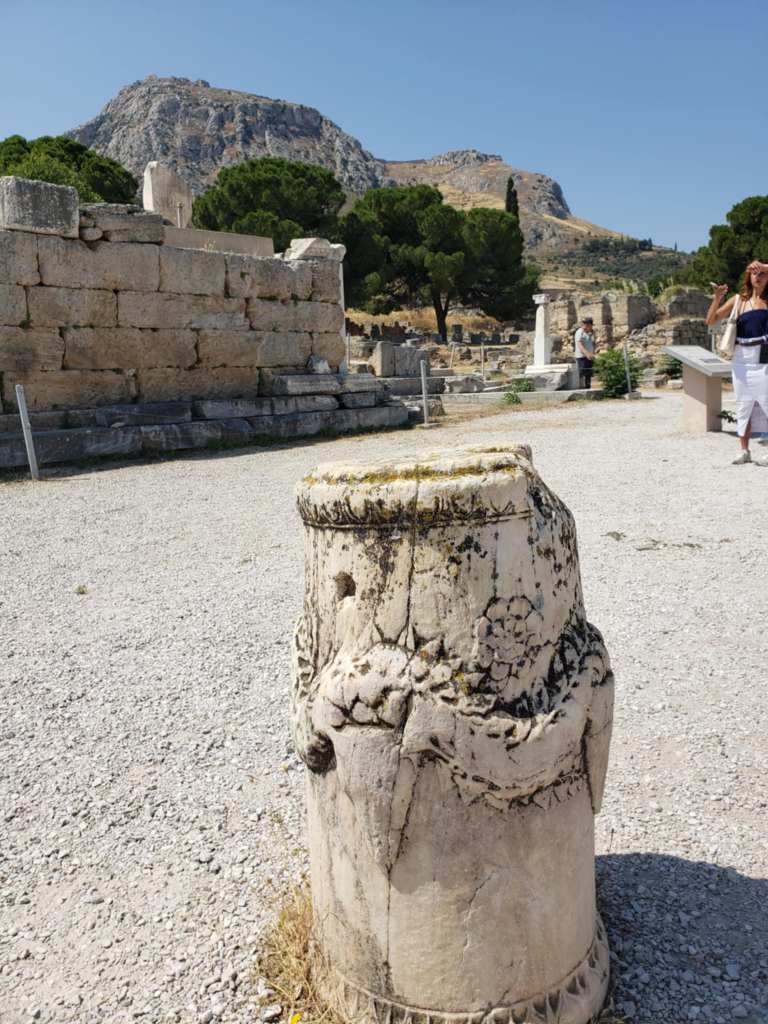
There are holes in it where chains appear to have been attached. Many scholars believe that the person on trial would have been chained there, which means Paul may have been chained there in front of Gallio. But if you notice in the picture, he wouldn’t have been just in front of the Roman judge but he would also have stood in front of the temple of Aphrodite. He was being judged politically and religiously.
Acts 18:14-17
But when Paul was about to open his mouth, Gallio said to the Jews, “If it were a matter of some crime or vicious, unscrupulous act, O Jews, it would be reasonable for me to put up with you; but if there are questions about teaching and persons and your own law, see to it yourselves; I am unwilling to be a judge of these matters.” And he drove them away from the judgment seat. But they all took hold of Sosthenes, the leader of the synagogue, and began beating him in front of the judgment seat. And yet Gallio was not concerned about any of these things.
Gallio didn’t care. Go ahead, beat up on your own kind. And so Sosthenes was brutally attacked. But who was Sosthenes? We know that Crispus, the leader of the Synagogue became a follower of Jesus after the teachings of Paul. Right? We just read that. But in this passage we’re told that Sosthenes was the leader of the Synagogue. It appears that Sosthenes was Crispus’ replacement who ALSO began to follow the teachings of Jesus. No wonder the Jews dragged Paul to the Proconsul… he kept “corrupting” their leaders! But why did they beat up on Sosthenes instead of Paul? Technically Paul was the one on trial! Paul had Roman citizen status and he had just escaped the judgement of Gallio… but they wanted someone to pay, and Sosthenes was an easy target. They turned on the man who, they probably felt, had turned on them. Paul was an outsider. You can expect people-from-away to not conform to your standards. But one of your own?! They should know better… and so Sosthenes became the target of their rage.
And this isn’t the last time we hear about Sosthenes! He shows up in a letter. Easy question: who wrote the letters to the Corinthians? Paul, yes? But was it just Paul?
1 Corinthians 1:1-2a
[From] Paul, called to be an apostle of Christ Jesus by the will of God, and our brother Sosthenes, to the church of God in Corinth…
Sosthenes was a co-writer of the letter to the Corinthians. Paul was a traveller and visitor, living in Corinth for a year and a half, but it appears that Sosthenes was a home boy. It would have meant a great deal to the home church in Corinth to have greetings from Sosthenes whom they probably knew much longer than Paul.
Much of the letter uses “I” language, so it was likely in the voice of Paul, but together they may have discussed what needed to be addressed in the letter. Sosthenes had input to the letter’s content and message… and he, along with Paul, were familiar with one of the heaviest issues weighing down on Corinth: prostitution. The letter asks the Corinthians…
1 Corinthians 6:15-20
Do you not know that your bodies are parts of Christ? Shall I then take away the parts of Christ and make them parts of a prostitute? Far from it! Or do you not know that the one who joins himself to a prostitute is one body with her? For He says, “THE TWO SHALL BECOME ONE FLESH.” But the one who joins himself to the Lord is one spirit with Him. Flee sexual immorality. Every other sin that a person commits is outside the body, but the sexually immoral person sins against his own body. Or do you not know that your body is a temple of the Holy Spirit within you, whom you have from God, and that you are not your own? For you have been bought for a price: therefore glorify God in your body.
Here’s the message: you, and the body you live in, are sacred space… you are never to violate your own sacred space or the sacred space of others. This is why rape is wrong and prostitution is wrong. Every single human is made in God’s image which means you are sacred space… and everyone you are with is sacred space. Prostitutes are no less sacred in God’s eyes than you are. And this is what Paul and Sosthenes really wanted to get across! Their message is more than just a “prostitution is bad” statement. It’s identifying your worth in the eyes of God… how wonderfully important YOU are to Him… so much so that you house His Spirit.
The great mathematician and theologian, John Lennox, in one of his many interviews, said this:
The heavens show God’s glory but they weren’t made in His image. YOU were! Which implies that you are more important than a galaxy!
.. and if you’re more important, in God’s eyes, than a galaxy, so is every single human you meet. The Temple Prostitutes of Corinth were, by and large, slaves sold off to the temple by desperate families, or acquired by the temple as exposed children. These weren’t prostitutes by choice; they were products of human trafficking. But God loved them and no doubt grieved for them.
You see, violating ourselves and violating others drags us down from the glory we were meant to possess! And it takes advantage of the weak, the young, the vulnerable. And most of the Roman men of Corinth had no problem with that because in Roman society people who were strong, established and powerful were seen as the winners in society.
But in God’s eyes, as soon as you claim dominance over another human, you’re violating one of God’s Image Bearers. Recall when Jesus said, “what you do to the least of these you do to Me?” And so Paul came storming into town with this radical idea of compassionate love… and the people responded!
In the midst of all the craziness, Corinth developed a devoted community of Jesus followers. And here’s the ironic thing, in a town where women were used as commodities, one of the early house churches in Corinth was led by a woman. And we know her name! 1 Cor 1:11 tells us that Paul and Sosthenes heard, from Chloe’s house-church, that there were some divisive quarrels within the community of believers. They dropped Chloe’s name in the letter as if everyone would know who they were talking about… and they would have! Chloe’s house was the gathering place for believers! And clearly Chloe and “the household” kept Paul in the loop, through letters, as to how the community was doing.
If you visit Corinth today, you will find an engraved stone up on the Bema. It quotes Paul’s second letter to the Corinthians:

2 Corinthians 4:17
For this slight momentary affliction is preparing for us an eternal weight of glory beyond all comparison.
Paul understood affliction and pain. He was dragged and likely chained in front of the Roman proconsul to be judged. And when the case was dismissed he had to witness the terrible beating of his friend. Paul was beaten, imprisoned or shipwrecked many times in his life… but not in Corinth. God promised him he wouldn’t be harmed, but he was not protected from seeing the suffering that surrounded him. And the only thing that got him through such emotional pain was the hope for a better ending- an eternal glory that awaited him at the end of his days.
That’s what we all want, isn’t it? To know that the suffering was worth it? You see, God didn’t create us and leave us hanging. He participated in human suffering. He put Himself in the midst of it. He suffered physically, emotionally, and mentally… and bore the full weight of what it meant to be living in our shoes. He didn’t have to do it… but He did. Why? Because love is at the core of the message. He loves you more than a galaxy. If you’ve felt low, abused, beaten, exhausted, un-loved, take heart! There is a great glory that awaits you. At the end of your days God will be there, with open arms, to welcome you home with the love you have always deserved (no matter how undeserving you feel). God sees it differently. He has a whole galaxy of love for you!
Next week: Sermon- Women in the Early Christian Church Movement

 Hebrew Word Lessons
Good job Sarah & God bless you!
LikeLike