

It’s my last week of blog vacationing… next week we’ll have a new Hebrew word, I promise! This week I’m just going to share with you some pictures of our trip, following Paul around to some of the places he visited on his second, third, and final journey to Rome.
Paul’s first missionary journey, outlined in Acts 13-14, was primarily in South Asia minor (Antioch of Pisidia, Iconium, Lystra, Derbe, Perga, and Attalia) and Cyprus (Salamis and Paphos). The book of Galatians also lets us know that he spent some time in Arabia, Syria and Cilicia (Galatians 1:15-24) at the beginning of his ministry. We didn’t get to any of those locations.
ATHENS
Paul’s second missionary journey was from Antioch across to Macedonia (Phrygia, Galatia, Philippi, Thessalonica, Berea) and onwards to Athens, Corinth and Ephesus, before returning to Antioch. We started our Pauline journey in Athens where we had the chance to visit the Acropolis, the Areopagus at sunset (aka Mars Hill) where Paul preached his “Unknown God” sermon (see the previous posting if you’d like to read about that experience), and the Ancient Agora with its impressive Temple of Hephaestus which was already over 400 years old when Paul wandered around Athens. Although there was a good chance that Paul was up at the Parthenon, he likely spent much more time in the Agora (marketplace) where the everyday people were gathered.


CORINTH
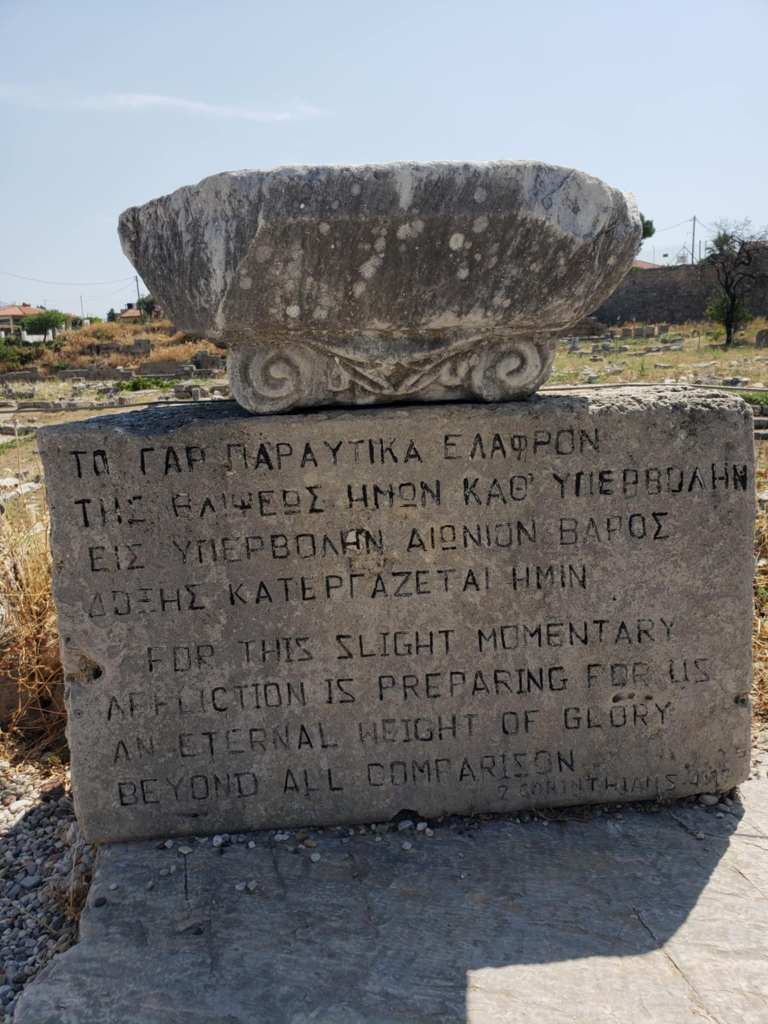
From Athens we took a day trip to Corinth where Paul visited a few times. In fact, in his first visit he stayed for a year and a half (Acts 18:11). This was where he initially met Priscilla and her husband Aquilla, fellow tent makers and followers of the Way who had come from Rome after Rome expelled the Jews. In Corinth, Paul had a run-in with the Jewish elite (no surprise). They wanted Rome to ban Paul, but the Roman proconsul, Gallio, dismissed the case:
Acts 18:12-17
But while Gallio was proconsul of Achaia, the Jews rose up together against Paul and brought him before the judgment seat, saying, “This man is inciting the people to worship God contrary to the law.” But when Paul was about to open his mouth, Gallio said to the Jews, “If it were a matter of some crime or vicious, unscrupulous act, O Jews, it would be reasonable for me to put up with you; but if there are questions about teaching and persons and your own law, see to it yourselves; I am unwilling to be a judge of these matters.” And he drove them away from the judgment seat. But they all took hold of Sosthenes, the leader of the synagogue, and began beating him in front of the judgment seat. And yet Gallio was not concerned about any of these things.



EPHESUS
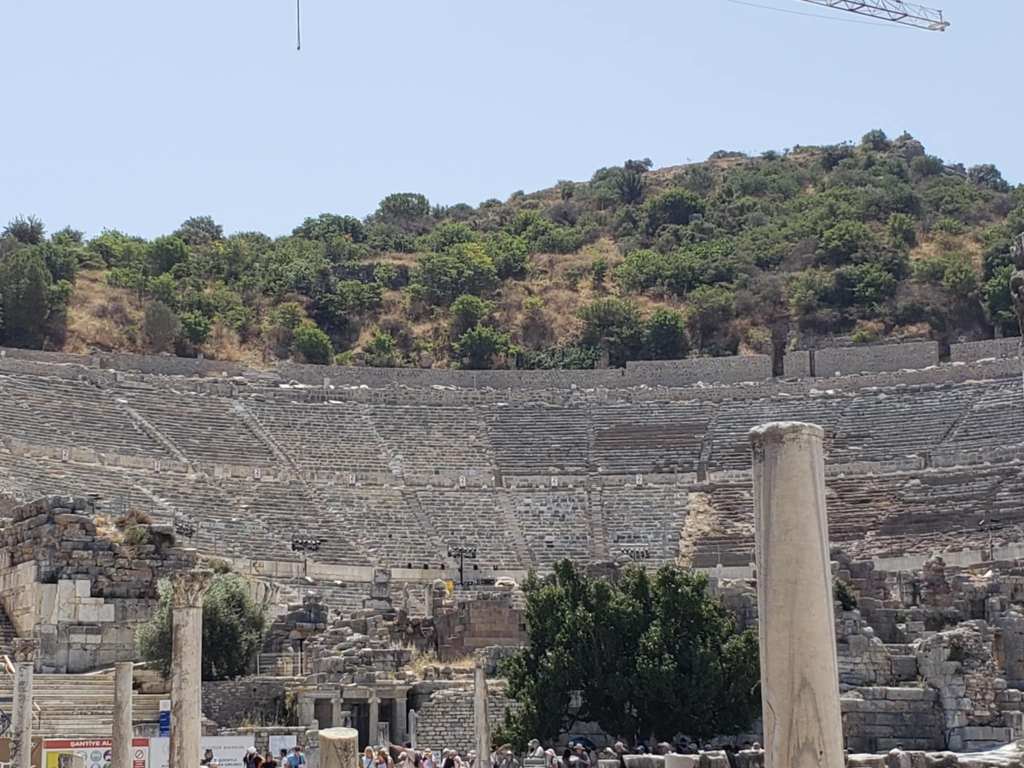
Our next “Paul” spot was Ephesus. Paul visited Ephesus more than once and lived there for about three years (alongside Priscilla and Aquilla who had moved to Ephesus). The craftsmen in town, who carved images of the gods, were upset at Paul for damaging the reputation of their business. They started a riot, inciting the people to call to the goddess, Artemis:
Acts 19:23-28
About that time a major disturbance occurred in regard to the Way. For a man named Demetrius, a silversmith who made silver shrines of Artemis, was bringing considerable business to the craftsmen; 25he gathered these men together with the workmen of similar trades, and said, “Men, you know that our prosperity depends upon this business. You see and hear that not only in Ephesus, but in almost all of Asia, this Paul has persuaded and turned away a considerable number of people, saying that gods made by hands are not gods at all. Not only is there danger that this trade of ours will fall into disrepute, but also that the temple of the great goddess Artemis will be regarded as worthless, and that she whom all of Asia and the world worship will even be dethroned from her magnificence.”
When they heard this and were filled with rage, they began shouting, saying, “Great is Artemis of the Ephesians!”
Eventually the whole town rushed to the Theatre and for two hours shouted, “Great is Artemis of the Ephesians!” The crowd was eventually brought under control and not long afterwards, Paul left for Macedonia.

RHODES
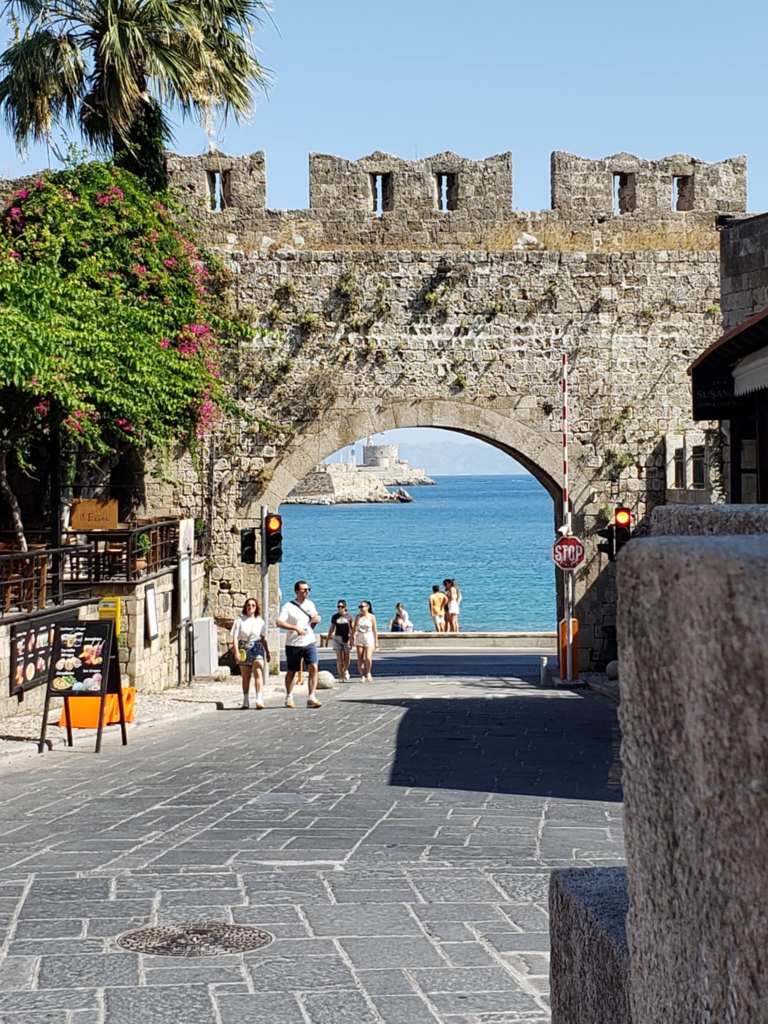
After Ephesus we set sail and headed to the Greek isle of Rhodes. Rhodes is only mentioned briefly. At the tail end of Paul’s third missionary journey he decided to sail past Ephesus because he was in a rush to get to Jerusalem for Shavuot (Pentecost). However, he did call on the elders of Ephesus to meet him. He gave a heartfelt and tearful farewell speech to his Ephesian church family (Acts 20:17-38) before heading home to Israel:
Acts 21:1-3
After we had torn ourselves away from them, we sailed directly to Cos, and the next day on to Rhodes, and from there to Patara. Finding a ship crossing over to Phoenicia, we boarded it and set sail. After sighting Cyprus and passing south of it, we sailed on to Syria and landed at Tyre, where the ship was to unload its cargo.
CRETE
Our next stop, after Rhodes, was the Greek island of Crete. According to Acts 2:11, Cretans were at the day of Pentecost and heard the Spirit-filled crowd speaking their own language. This was an early indication of Crete’s connection to early Christianity. Another indication of a Christian community in Crete was that Paul assigned Titus to stay on Crete in order to appoint elders for the church community:
Acts 1:5
[Paul to Titus:] The reason I left you in Crete was that you would set in order what was unfinished and appoint elders in every town, as I directed you.

There’s a good chance that Paul was in Crete before his known visit at the end of his ministry. On the way to Rome (where, it seems, his mortal life would come to an end) he was on a ship that docked in Fair Haven, Crete. Paul tried to encourage the ship crew to stay in Crete but they were determined to get to Rome. As a result they faced a violent storm on the sea:
Acts 27:7-26
After sailing slowly for many days, we arrived off Cnidus. When the wind impeded us, we sailed to the lee of Crete, opposite Salmone. After we had moved along the coast with difficulty, we came to a place called Fair Havens, near the town of Lasea. By now much time had passed, and the voyage had already become dangerous because it was after the Fast So Paul advised them, “Men, I can see that our voyage will be filled with disaster and great loss, not only to ship and cargo, but to our own lives as well.”
But contrary to Paul’s advice, the centurion was persuaded by the pilot and by the owner of the ship. Since the harbor was unsuitable to winter in, the majority decided to sail on, hoping that somehow they could reach Phoenix to winter there. Phoenix was a harbor in Crete facing both southwest and northwest.
When a gentle south wind began to blow, they thought they had their opportunity. So they weighed anchor and sailed along, hugging the coast of Crete. But it was not long before a cyclone called the Northeaster swept down across the island. Unable to head into the wind, the ship was caught up. So we gave way and let ourselves be driven along.
Passing to the lee of a small island called Cauda, we barely managed to secure the lifeboat. After hoisting it up, the crew used ropes to undergird the ship. And fearing that they would run aground on the sandbars of Syrtis, they lowered the sea anchore and were driven along.
We were tossed so violently that the next day the men began to jettison the cargo. On the third day, they threw the ship’s tackle overboard with their own hands. When neither sun nor stars appeared for many days and the great storm continued to batter us, we abandoned all hope of being saved.
After the men had gone a long time without food, Paul stood up among them and said, “Men, you should have followed my advice not to sail from Crete. Then you would have averted this disaster and loss. But now I urge you to keep up your courage, because you will not experience any loss of life, but only of the ship. For just last night an angel of the God to whom I belong and whom I serve stood beside me and said, ‘Do not be afraid, Paul; you must stand before Caesar. And look, God has granted you the lives of all who sail with you.’
So take courage, men, for I believe God that it will happen just as He told me. However, we must run aground on some island.”
MALTA
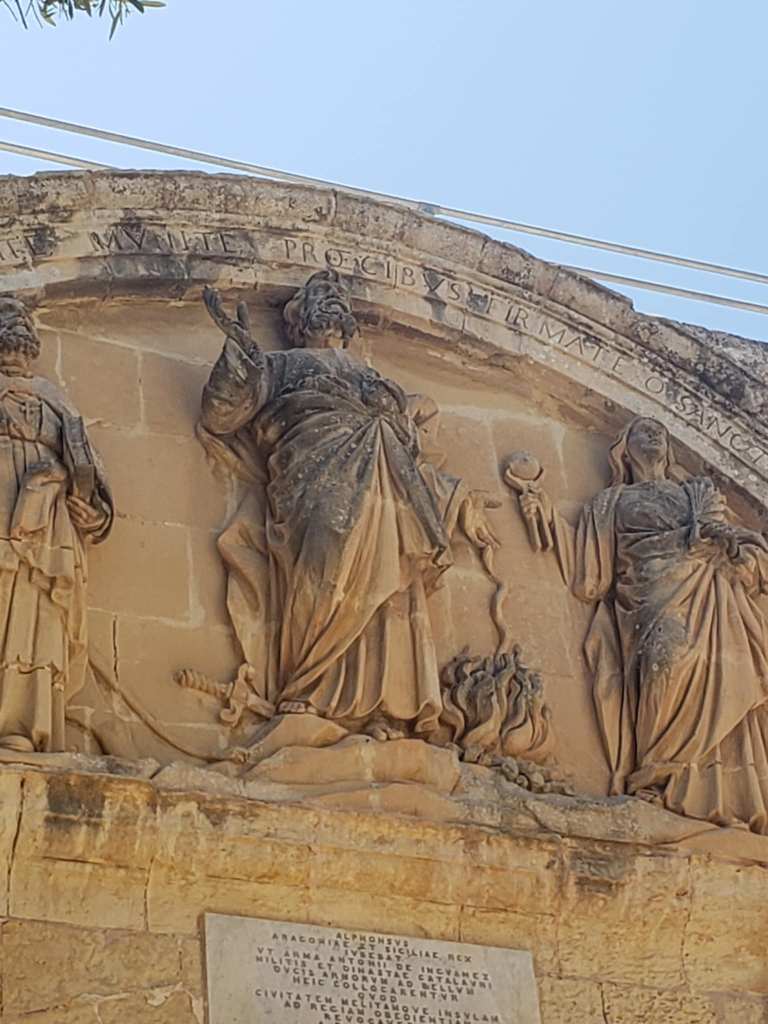
“Some island” turned out to be Malta, where Paul and his fellow sailors were shipwrecked. This was also our next destination. Like Paul, we left Crete and arrived in Malta (fortunately for us, we arrived in calm waters). In order to feel Paul’s experience a little closer, I started each evening with an attempt to sleep under the stars on our ship balcony. I would often make it well into the night before grabbing the pillows and heading inside for a more comfortable bed. I recall one very windy night that made me think of Paul and his stormy ride between Crete and Malta.
Malta is crammed with megalithic structures. By Paul’s time it had had a very long and impressive history of civilisation. We visited one of these necropolis burial chambers known as the Ħal Saflieni Hypogeum. This burial chamber was built 4000 years before Paul found himself ship-wrecked on the Island. Clearly there was a long religious history attached to Malta and it’s not surprising that the people saw in Paul a connection to the spirit world, especially after he survived a deadly snake bite:
Acts 28:1-10
When they had been brought safely through, then we found out that the island was called Malta. The natives showed us extraordinary kindness, for they kindled a fire and took us all in because of the rain that had started and because of the cold.
But when Paul had gathered a bundle of sticks and laid them on the fire, a viper came out because of the heat and fastened itself on his hand. When the natives saw the creature hanging from his hand, they began saying to one another, “Undoubtedly this man is a murderer, and though he has been saved from the sea, justice has not allowed him to live.”
However, Paul shook the creature off into the fire and suffered no harm. Now they were expecting that he was going to swell up or suddenly fall down dead. But after they had waited a long time and had seen nothing unusual happen to him, they changed their minds and began to say that he was a god.
Now in the neighbouring parts of that place were lands belonging to the leading man of the island, named Publius, who welcomed us and entertained us warmly for three days. And it happened that the father of Publius was lying in bed afflicted with a recurring fever and dysentery. Paul went in to see him, and after he prayed, he laid his hands on him and healed him. After this happened, the rest of the people on the island who had diseases were coming to him and being cured. They also showed us many honours, and when we were about to set sail, they supplied us with everything we needed.
ROME
Paul and the ship’s crew stayed in Malta for three months (Acts 28:11) before they headed to Rome.
The next stop on our tour was Naples and Herculaneum. Check out the previous post on Paul’s connection to this area. We then set sail for Rome, where we would finish our vacation with four days in the “eternal city”. We had a chance to see many things in Rome, including the Roman forum (where Paul undoubtedly spent some time), as well as the Mamertine Prison where Paul and Peter were allegedly incarcerated.

Acts 28:30-31
Now Paul stayed two full years [in Rome] in his own rented lodging and welcomed all who came to him, preaching the kingdom of God and teaching things about the Lord Jesus Christ with all openness, unhindered.
This is how the book of Acts ends, but history has hinted that Paul died in Rome. There is a letter (known as 1 Clement) that was written from the church in Rome to the church in Corinth around 95AD. The letter spoke of Paul’s death, but not the manner by which he was killed. Early theologians (known as the Church Fathers) indicated that Paul was beheaded in Rome, but those were written a couple hundred years after the event. The 1 Clement letter (written about 30 years after Paul’s death) talked about Paul’s (and Peter’s) demise without explicitly giving us details, although it does leave a possible hint. See if you can find it :
1 Clement 5:1-6
But, to pass from the examples of ancient days, let us come to those champions who lived nearest to our time. Let us set before us the noble examples which belong to our generation. By reason of jealousy and envy the greatest and most righteous pillars of the Church were persecuted, and contended [fought] even unto death.
Let us set before our eyes the good Apostles. There was Peter who by reason of unrighteous jealousy endured not one not one but many labours, and thus having borne his testimony went to his appointed place of glory.
By reason of jealousy and strife Paul by his example pointed out the prize of patient endurance. After that he had been seven times in bonds, had been driven into exile, had been stoned, had preached in the East and in the West, he won the noble renown which was the reward of his faith, having taught righteousness unto the whole world and having reached the farthest bounds of the West; and when he had borne his testimony before the rulers, so he departed from the world and went unto the holy place, having been found a notable pattern of patient endurance.
A later recurring (and very plausible) belief was that Paul was persecuted and killed during the time of Nero. The letter hints that “the most righteous pillars of the Church were persecuted, and contended [fought] even unto death” which might suggest that Paul (certainly a most righteous pillar of the church) was sent into the Arena to fight for his life. The Colosseum, of course, never had a fair fight. It’s a fitting image. If Paul stood in the Roman Colosseum, he stood in front of the biggest audience in Rome. I bet he had something to say before he took his final breath. We’ll never know, but YHWH does! It’s a story I’d like to hear when I get to heaven.


Next week: the WALL (Part 2).

 Hebrew Word Lessons
THANK YOU so much for taking us with you and sharing the photos. That
was much needed and well done!
YHWH blessings are with you Sarah.
Ashley
LikeLike