

The Hebrew alphabet starts with two letters: aleph and bet, so what we call the alphabet we should really be calling the aleph-bet! Yes, the word alphabet comes from ancient Semitic, which is a branch of Afroasiatic language groups. Semitic languages include ancient Hebrew, Aramaic, Ugaritic, Syriac, Phoenician, and Akkadian, to name a few.
The ancient Hebrew language, just like any other language, is not exclusively Hebrew. Just as English uses loan words from other languages (like croissant and hallelujah), so does the ancient Hebrew language use loan words from other neighbouring Semitic languages. For example, the Hebrew word for spirits of the dead (Isaiah 19:3), exorcist (Daniel 1:20, 2:2), sorcery (Micah 5:22), constellations/zodiac (2 Kings 23:5), demons (Deut 32:17; Ps 106:37) were all Akkadian loan words. (If you’re interested in reading more about that, check out “Akkadian Loanwords in Biblical Hebrew” by Paul V. Mankowski, published in Harvard Semitic Studies, 2018). This means that the Bible is rich with Semitic cultural influences. It speaks from a time and a place very foreign to our 21st century perspective but, at the same time, relevant to our understanding of the human condition across the ages. The words of the Bible are time-sensitive and, at the same time, timeless… full of beautiful truths and harsh realities.
It should come to no surprise that I love Biblical Hebrew. I love its vowelless complexities and the way it sounds. I’m intrigued by how the shape of the letters have changed over time, from proto-Hebrew lettering to the boxy Aramaic lettering that we see today. All in all, the Hebrew language has an incredible history. Considering Hebrew was lost as a community language (existing only in ritual/sacred ceremonies), its revival is quite a story! One man, Eliezer Ben Yehuda, brought it back to life after centuries of extinction. As a result his children, Itamar and Dola, were the first native speaker of Hebrew in modern times. Now there are 5-6 million native speakers of Hebrew when 150 years ago there were none.
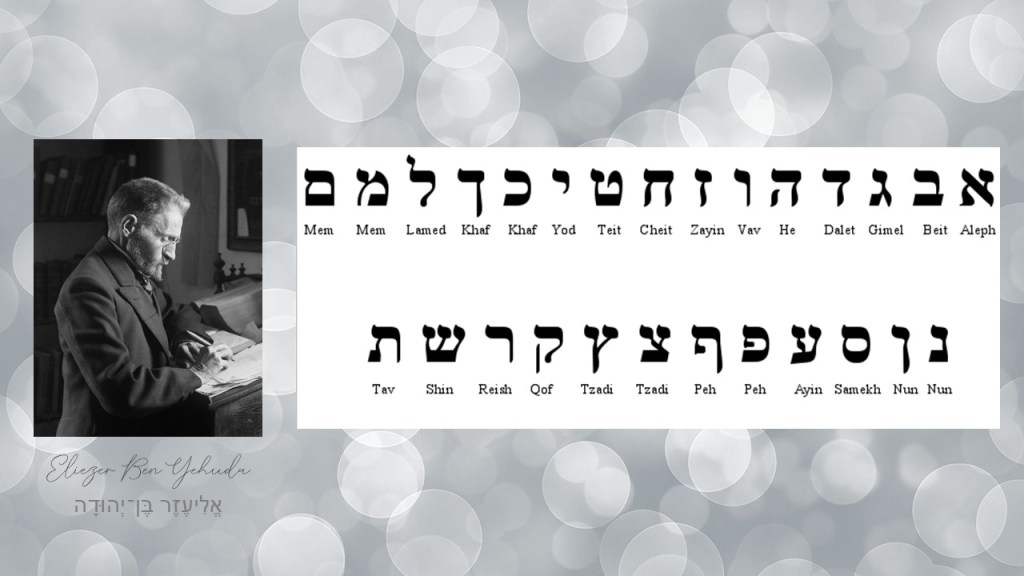
My first step in learning Biblical Hebrew was to learn the Hebrew aleph-bet, first audibly, by letter, and then visually. I highly recommend learning the Hebrew aleph-bet, even just for fun (yes, this passes as fun in my books!). It’s a rewarding endeavour! I learned the aleph-bet years ago by going for walks around UPEI on my lunch break. I started with aleph, bet, gimmel, dalet, hey… and then every day I’d add a letter or two. Before long I was quietly reciting the full set of 22 letters.
All this to say, the HebrewWordLesson alphabetised (or should I say “alephbetised”) Word Lists are now up-to-date! See if the word you’ve been waiting for is there. You can always drop me a line to suggest words that you would like to see!
A-H
I-Q
R-Z
Next week: Govern/Government

 Hebrew Word Lessons
Thank you, Sarah, for your updated word list. What a valuable resource for Bible students of all faiths.
😭interfaith
LikeLike
Happy to help! 🙂
LikeLike