

Revisiting SING (SHIR)
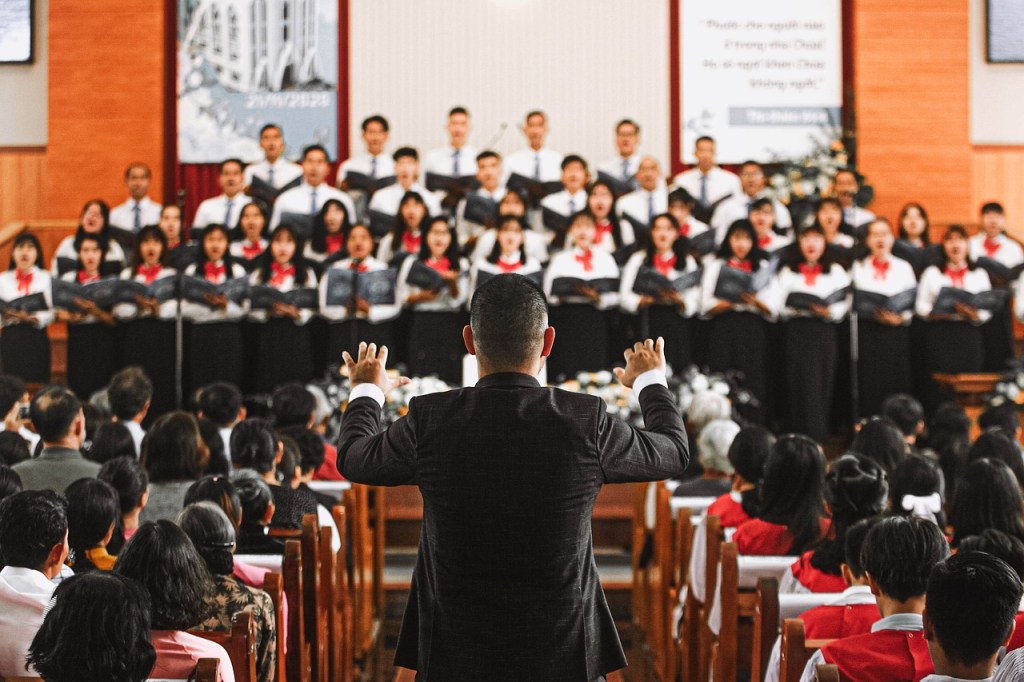
I love singing. As a child, my earliest memories of singing was at church and in my elementary school (KTTPS) choir under the leadership of the late Mr. Dale Haldenby. I remember singing around campfires and at camp, and singing along to tunes in the car. In High School I joined the jazz choir (under the leadership of Mr. Ian Bubrdge) and in University I was thrilled to make the cut to join the highly respected Conrad Grebel College Chapel Choir (under the leadership of Dr. Len Enns). I mention all these great choir directors because they instilled in me a great love and enthusiasm for singing. I particularly remember their big smiles in the middle of performances in order for us to emit big smiles to the audience.
This kind of big-smile-joy singing can be found in the first recorded song in the Bible, found in the book of Exodus.
Exodus 15:1-19
[The singers: Moses and the sons of Israel, followed by Miriam and the daughter of Israel]
[The setting: just after the Hebrew people crossed the Red (Reed) Sea and escaped the Egyptians (who, chasing after them, drowned in the sea)]
Then Moses and the sons of Israel sang [ya-shir יָשִֽׁיר] this song [et ha-shirah הַשִּׁירָ֤ה] to YHWH, saying:
“I will sing [a-shirah אָשִׁ֤ירָה] to YHWH, for He is highly exalted; the horse and its rider He has hurled into the sea. YHWH is my strength and song (melody), and He has become my salvation; this is my God, and I will praise Him; my father’s God, and I will exalt Him.
YHWH is a warrior; YHWH is His name. Pharaoh’s chariots and his army He has thrown into the sea; and the choicest of his officers are drowned in the Red Sea. The waters cover them; they went down into the depths like a stone.
Your right hand, YHWH, is majestic in power; Your right hand, YHWH, destroys the enemy. And in the greatness of Your excellence You overthrow those who rise up against You; You send out Your burning anger, and it consumes them like chaff. At the blast of Your nostrils the waters were piled up, the flowing waters stood up like a heap; the depths were congealed in the heart of the sea.
The enemy said, ‘I will pursue, I will overtake, I will divide the spoils; I shall be satisfied against them; I will draw my sword, my hand will destroy them.’ You blew with Your wind, the sea covered them; they sank like lead in the mighty waters.
Who is like You among the gods, YHWH? Who is like You, majestic in holiness, awesome in praises, working wonders? You reached out with Your right hand, the earth swallowed them. In Your faithfulness You have led the people whom You have redeemed; in Your strength You have guided them to Your holy habitation.
The peoples have heard, they tremble; anguish has gripped the inhabitants of Philistia. Then the chiefs of Edom were terrified; the leaders of Moab, trembling grips them; all the inhabitants of Canaan have despaired. Terror and dread fall upon them; by the greatness of Your arm they are motionless as stone, until Your people pass over, YHWH, until the people pass over whom You have purchased. You will bring them and plant them in the mountain of Your inheritance, the place, YHWH, which You have made as Your dwelling, the sanctuary, Lord, which Your hands have established. YHWH shall reign forever and ever.”
In response, Miriam picked up a tambourine and sang a refrain, and all the woman followed Miriam, grabbed their tambourines and danced to the music:
Exodus 15:20-21
Miriam the prophetess, Aaron’s sister, took the tambourine in her hand, and all the women went out after her with tambourines and with dancing. And Miriam answered them,
“Sing to YHWH [Shiru l-YHWH שִׁ֤ירוּ לַֽיהוָה֙], for He is highly exalted; the horse and his rider He has hurled into the sea.”
This song is what you would traditionally call a “ballad” (a song that tells a story); it is also a traditional folk song (a song originating from a particular people group). But what it ultimately was, was a song of great joy! It was a song of rescue and redemption and salvation! We should all be shouting, “Shiru l-YHWH!”
As far as I’m aware, there is only one mention of singing in the Gospels and it followed the Last Supper:
Mark 14:22-28
While they were eating, He took some bread, and after a blessing He broke it, and gave it to them, and said, “Take it; this is My body.” And when He had taken a cup and given thanks, He gave it to them, and they all drank from it. And when He had taken a cup and given thanks, He gave it to them, and they all drank from it. And He said to them, “This is My blood of the covenant, which is being poured out for many. Truly I say to you, I will not drink of the fruit of the vine again, until that day when I drink it, new, in the kingdom of God.”
And after singing a hymn [Greek: hymnesantes], they went out to the Mount of Olives.
And Jesus said to them, “You will all fall away, because it is written: ‘I will strike the shepherd, and the sheep will be scattered.’ But after I am raised, I will go ahead of you to Galilee.”
Why only one mentioned song? First of all, singing after the Passover meal was common, so it was not a surprise that the Yeshua (Jesus) and the disciples sang together after their meal. Jewish tradition suggests that the last part of the Hallel (Psalm 113-118) was the post-meal hymn. But the fact that gospel authors don’t mention singing during the rest of Yeshua’s life may be because they wanted to highlight that Yeshua’s life was leading to a time of intense mourning… the crucifixion.
James 5:13
Is anyone among you suffering? Then he must pray. Is anyone cheerful? He is to sing praises [Greek: psalleto].
Certainly, there was a lot more mention of prayer in Yeshua’s life-story, than of singing. It wasn’t until after His death and resurrection that the singing really comes into fruition in the New Testament. This, of course, makes sense in light of the beautiful, and cheerful, Gospel message that we are redeemed through the death and resurrection of Yeshua Ha-Mashiach (Jesus the Messiah):
Ephesians 5:18b-20
…be filled with the Spirit, speaking to one another in psalms and hymns [Greek: psalmois kai hymnois] and spiritual songs [odais], singing [adantes] and making melody [psallontes] with your hearts to the Lord; always giving thanks for all things in the name of our Lord Jesus the Messiah to our God and Father.
Sing to YHWH! Shiru l-YHWH! שִׁ֤ירוּ לַֽיהוָה֙! Be your own conductor, smile and sing, because you are redeemed and that’s worth singing about!
To read the original post on the Hebrew word meaning to SING, click below:
SHIR
Next week: Crying, proclaiming, shouting for joy!

 Hebrew Word Lessons